Dental Curing Light Guide: How Light Curing Works (and Why Your Operatory Light Needs an Anti-Curing Mode)
How a dental curing lamp works: blue LED light cure units, wavelength and irradiance, curing dental resin correctly, UV vs blue light — and why dental surgical lights need an anti-curing filter.

Every restorative dentist uses two kinds of light: the curing light that hardens composite, and the operatory or surgical light that illuminates the mouth. They work against each other unless the second one can switch off its blue. This guide explains how a dental curing lamp works and how to make the two coexist.
Key fact: dental composites harden when blue light (around 450–470 nm) activates their photo-initiator. Any strong white LED light contains some of that blue — which is why dental lights need an anti-curing mode.
How light curing works
- Light-cured resins contain a photo-initiator, most commonly camphorquinone, which absorbs blue light most strongly near 468 nm.
- When activated, it starts a chain reaction that links the resin monomers into a hard polymer.
- The amount of cure depends on irradiance (power per area, in mW/cm²) multiplied by time — the delivered energy.
Types of dental light cure units
| Type | Light source | Notes |
|---|---|---|
| Halogen (QTH) | Filtered tungsten-halogen | Older, hotter, bulb and filter degrade |
| Single-peak LED | Blue LED ~450–470 nm | Most common today |
| Polywave LED | Blue + violet LEDs | Cures materials with alternative initiators |
| Plasma arc / laser | High-intensity sources | Rare today |
"Dental UV light" refers to the first-generation UV curing systems; modern units use visible light.
Choosing a dental LED light cure unit
- Irradiance and a way to check it (built-in or separate radiometer).
- Spectrum — single-peak vs polywave for the materials you use.
- Tip diameter and beam uniformity.
- Cordless battery capacity and charging.
- Modes — standard, ramp, high-power.
- Eye protection — orange shields or glasses: blue light is hazardous to the retina.
Getting a reliable cure
- Hold the tip as close and perpendicular to the restoration as possible.
- Respect increment thickness and exposure times from the material manufacturer.
- Clean and inspect the light guide; check output regularly.
- Don't let the operatory light pre-cure material before you're ready.
The anti-curing mode on dental surgical lights
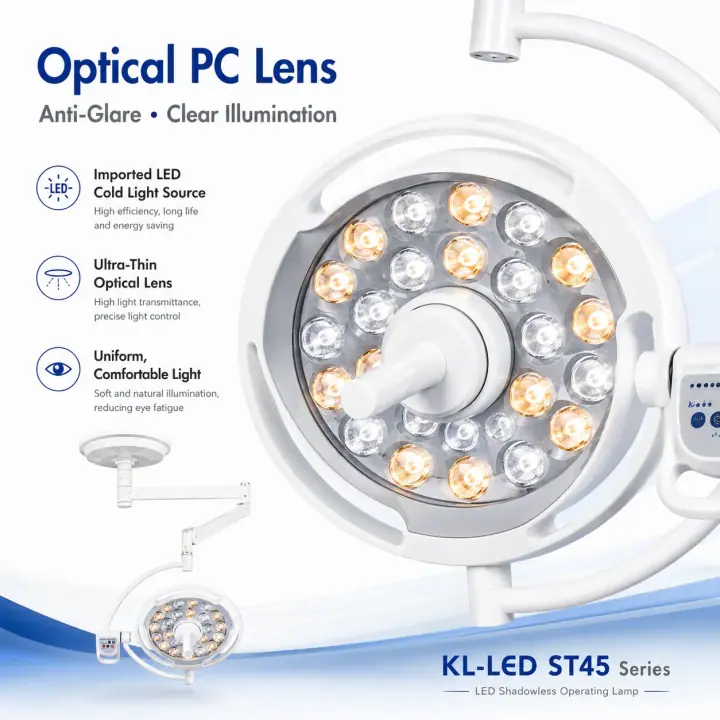
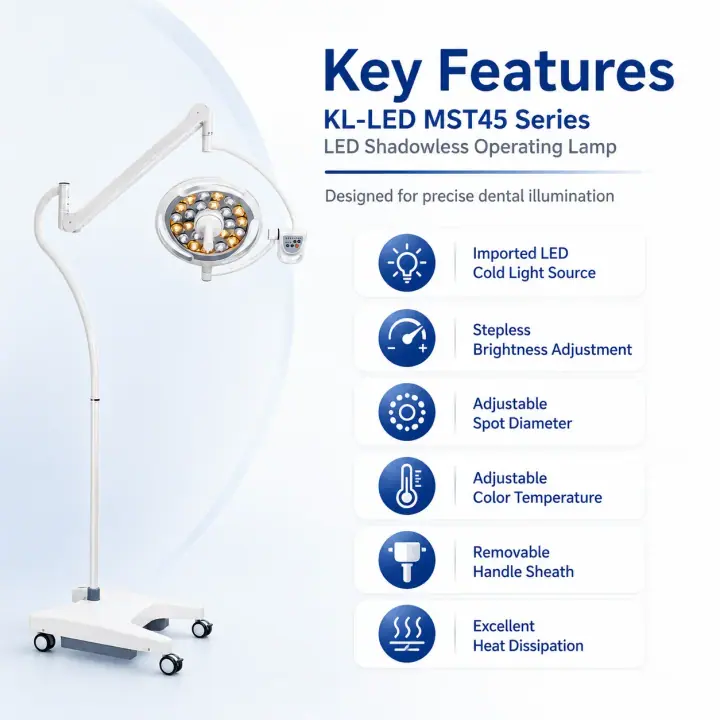
Implant and restorative procedures often combine surgical light and composite work. Keling's dental lights therefore include a one-key anti-curing function that removes UV and blue light from the beam, so composite stays workable while the field is still lit:
- KL-LED-ST45 — ceiling mounted, ≥ 80,000 lux at 1 m, precision spectral filter.
- KL-LED-MST45 — mobile version, same light engine.
For a broader comparison of operatory lights, see dental lights explained and lighting for dental implant surgery.
Safety
- Never look directly at a curing light; use the orange shield.
- Protect the patient's eyes too.
- Avoid prolonged exposure of soft tissue and pulp to high irradiance — heat builds up.
Distributing dental equipment? Ask about ST45/MST45 OEM options.
Frequently asked questions
What is a dental curing lamp?
A dental curing lamp (light cure unit) is a handheld device that emits intense blue light to polymerise — harden — light-cured dental materials such as composite resin, bonding agents, sealants and some cements.
What wavelength does a dental curing light use?
Most dental curing lights emit blue light of roughly 400–500 nm. Single-peak LED units centre near 450–470 nm, matching the photo-initiator camphorquinone; multi-peak (polywave) units add a violet peak around 400–410 nm for other initiators.
Is a dental curing light UV?
Modern dental curing lights use visible blue (and sometimes violet) light, not ultraviolet. Early systems in the 1970s used UV, which is why the term 'dental UV light' is still searched.
Why does my operatory light cure composite too early?
White LED operatory and surgical lights contain a blue component that can start polymerising composite left exposed on the instrument or tooth. An anti-curing (orange) mode filters that blue light out.
How long should you light cure dental resin?
Follow the material manufacturer's instructions; exposure time depends on the material, shade, increment thickness and the irradiance of the curing light. Typical increments are cured for several seconds to tens of seconds.