Medical Equipment Maintenance and Repair: A Surgical Light Service Guide for Biomedical Teams
Preventive maintenance and repair of surgical lights and medical equipment: daily, monthly and annual checks, common faults, spare parts, in-house biomedical repair vs service companies, and records.

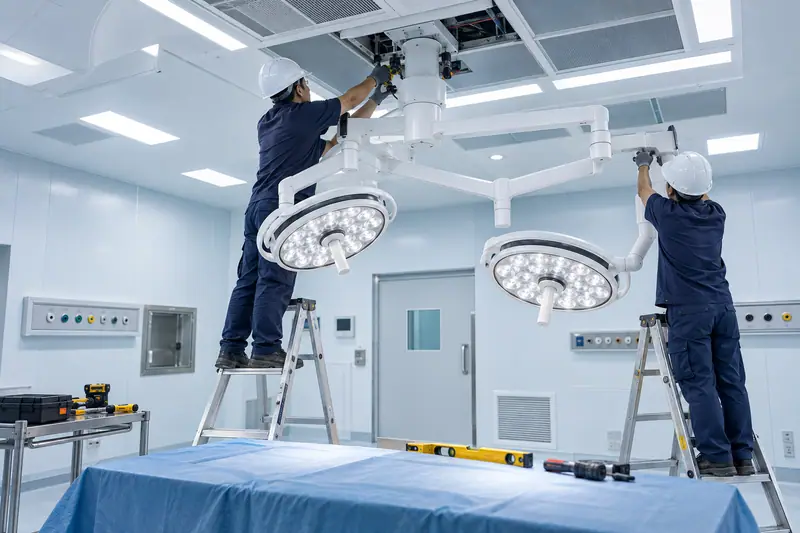
Well-maintained medical equipment lasts longer, fails less and passes audits. This guide focuses on surgical and examination lights — but the principles of medical equipment maintenance and repair apply to the whole operating theatre.
Bottom line: daily checks by users, monthly mechanical checks, annual preventive maintenance with illuminance measurement, documented repairs, and a stock of the right spare parts.
Preventive maintenance schedule
Daily (theatre staff)
- Switch on; check all intensity steps and endo mode.
- Check that heads stay where positioned.
- Inspect and fit sterilisable handles.
- Clean the lamp head and handles with an approved disinfectant (no abrasives, no solvent on lenses).
Monthly (biomedical / clinical engineering)
- Check arm joints, brakes and spring-arm balance.
- Inspect cables, covers and the control panel.
- Look for flickering or failed LED segments.
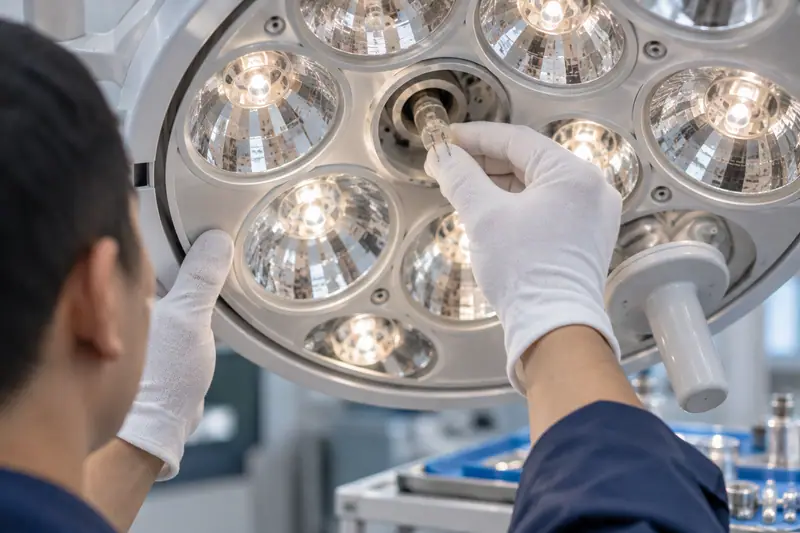
- For halogen lamps: check bulbs and contacts; replace blackened bulbs.
Annually (preventive maintenance inspection)
- Measure central illuminance at 1 m with a calibrated lux meter and compare with the datasheet — see how to use a lux meter.
- Check field size adjustment, colour temperature modes and camera function.
- Inspect ceiling fixings, suspension tube and central axis bolts.
- Electrical safety test (earth continuity, leakage) per IEC 62353 or local rules.
- Test switch-over to back-up power or battery.
- Update the maintenance record.
Common faults and fixes
| Symptom | Likely cause | Action |
|---|---|---|
| Arm drifts or sinks | Brake or spring tension out of adjustment | Re-adjust brakes/balance per manual |
| Lamp head won't stay tilted | Worn friction joint | Adjust or replace joint parts |
| One LED segment dark | LED module or connector | Check connector; replace module |
| Light flickers | Power supply, loose connector, dimmer fault | Inspect connections; replace driver |
| Halogen bulb fails often | Over-voltage, poor contact | Check transformer and holder — see changing a halogen bulb |
| Low illuminance | Dirty lens, ageing bulbs, wrong mode | Clean, replace bulbs, reset mode |
| Control panel unresponsive | Membrane switch or board fault | Replace panel or board |
| No camera image | Cable, power or setting | Check SDI cable, camera power, monitor input |
Always isolate power before opening any part of the light, and follow the manufacturer's service manual.
Spare parts to keep in stock
| Light type | Recommended spares |
|---|---|
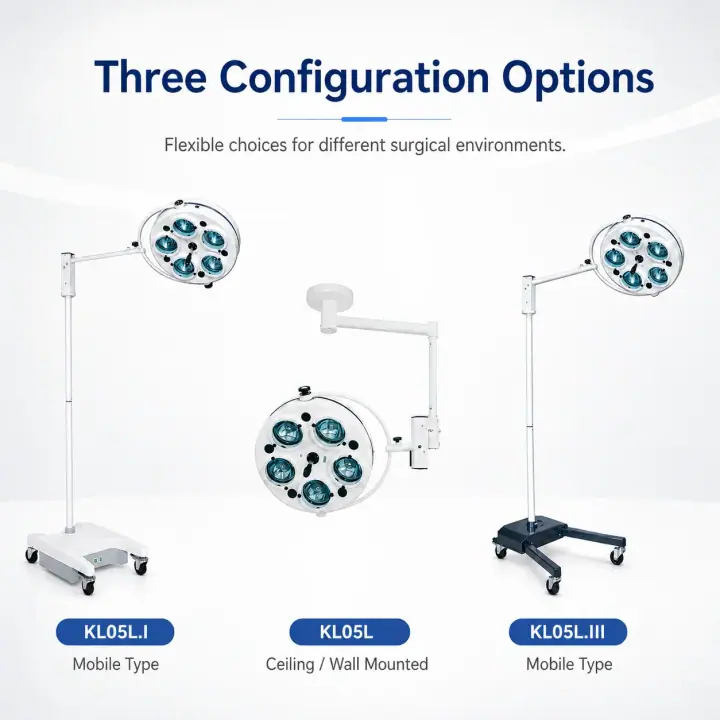
| Halogen (e.g. KL05L) | Bulbs (24 V 125 W for KL05L), fuses |
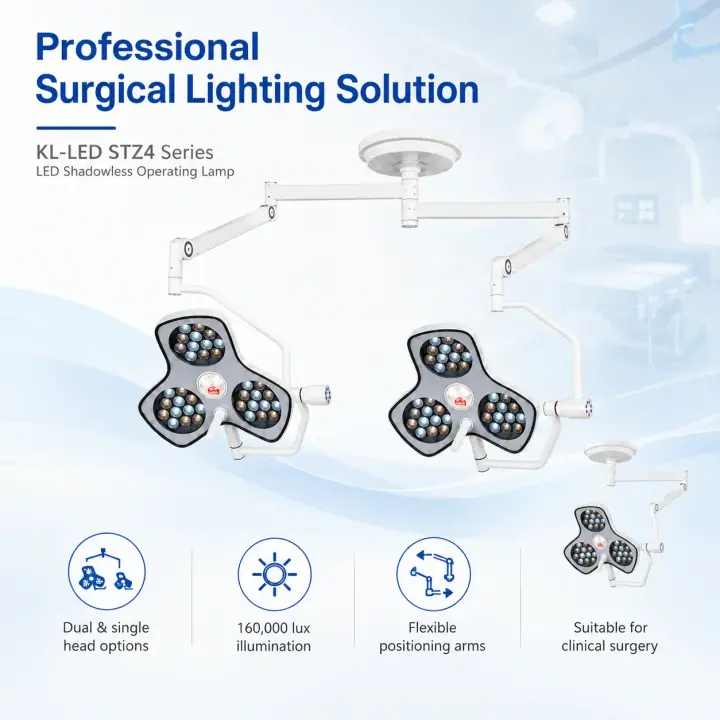
| LED ceiling (e.g. KL-LED-STZ4) | Sterilisable handles, power supply/driver, fuses |
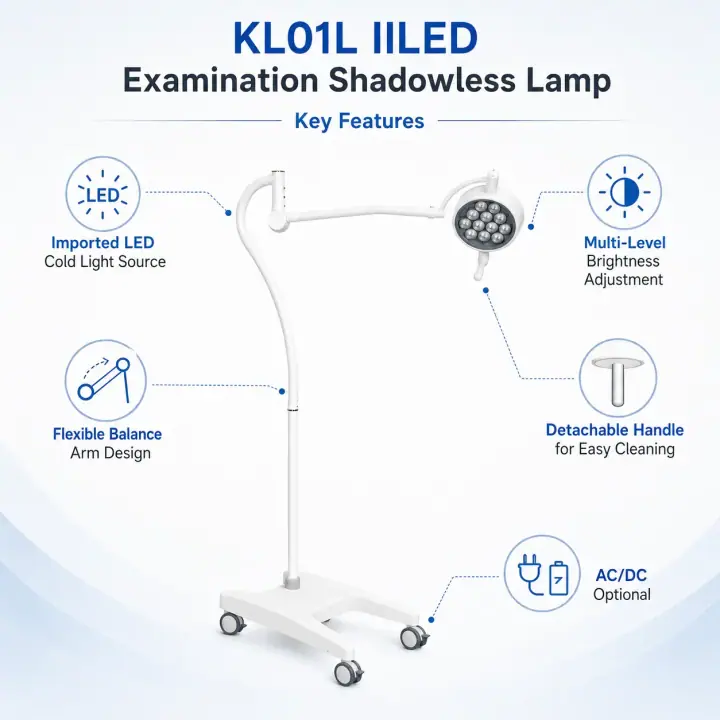
| Examination (e.g. KL01L-IILED) | Handle, power adaptor |
| Large fleets | LED module, control panel, arm brake parts |
In-house biomedical repair vs service companies
| Aspect | In-house biomedical team | Manufacturer / distributor | Independent service company |
|---|---|---|---|
| Response time | Fastest | Depends on location | Contract-dependent |
| Expertise | Broad | Deepest for its own products | Multi-vendor |
| Parts | Must stock | Original parts | Varies |
| Cost | Staff cost | Contract or per call | Contract or per call |
| Best for | PM, first-line repair | Complex repairs, upgrades | Multi-vendor fleets, small hospitals |
Many hospitals use in-house teams for routine biomedical equipment maintenance and call the manufacturer or distributor for complex repairs.
Documentation
- Asset register with serial numbers, location and install date.
- PM schedule and completed checklists.
- Repair log: fault, cause, parts, time.
- Lux measurements over time — a falling trend predicts end of life.
- Incident reports for any failure during surgery.
Designing for maintainability
When buying, ask for: service manuals, spare parts lists with prices, mean time to repair, training for local engineers and parts availability guarantees. LED lights cut routine maintenance dramatically compared with halogen — see LED vs halogen.
Support from Keling
Keling supplies spare parts, service documentation and remote technical support for its lights through distributors worldwide. Request a spares list or service support.
Frequently asked questions
How often should surgical lights be serviced?
Daily visual and function checks by theatre staff, monthly checks of arms, brakes and handles, and a full preventive maintenance inspection at least once a year — or as specified by the manufacturer and your hospital's medical equipment management plan.
What are common surgical light faults?
Arms drifting or not holding position, failed halogen bulbs or LED segments, flickering, control panel faults, damaged sterilisable handles, loose covers, and power supply failures.
Should hospitals repair medical equipment in-house or use a service company?
Many hospitals combine both: an in-house biomedical (clinical engineering) team handles preventive maintenance and first-line repair, while manufacturers, distributors or independent biomedical service companies handle complex repairs, calibration and specialist equipment.
What spare parts should I stock for surgical lights?
For halogen lamps, replacement bulbs and fuses; for LED lights, sterilisable handles, a spare power supply or driver board, and fuses. For large fleets, consider a spare LED module and arm brake parts. Ask the manufacturer for a recommended spares list per model.
Does Keling provide spare parts and technical support?
Yes. Keling supplies spare parts, service manuals and remote technical support to distributors and hospitals, and can train distributor engineers to service Keling surgical and examination lights.