Surgical Light Lux Requirements: How Much Light Does an Operating Room Need?
Surgical light lux requirements explained: the IEC 60601-2-41 range of 40,000–160,000 lux, typical lux by procedure and room, endo mode, D10/D50, depth of illumination and how to specify lux in a tender.

"How many lux do we need?" is the first question on almost every surgical lighting tender. The short answer is set by the international standard; the useful answer depends on the procedure, the room and the rest of the specification. This guide gives both.
Short answer: a surgical light must deliver 40,000–160,000 lux central illuminance at 1 m (IEC 60601-2-41). General surgery main lights are usually specified at 140,000–160,000 lux; minor surgery lights at 40,000–100,000 lux; examination lights lower.
What IEC 60601-2-41 specifies
The standard for surgical and diagnostic luminaires defines how lux is measured and what range is allowed:
| Parameter | Requirement / meaning |
|---|---|
| Central illuminance Ec at 1 m | 40,000–160,000 lux |
| Light field diameter D10 | Diameter where illuminance falls to 10% of Ec |
| Light field diameter D50 | Diameter where illuminance falls to 50% of Ec |
| Depth of illumination L1+L2 | Distance above and below the focus where light remains useful |
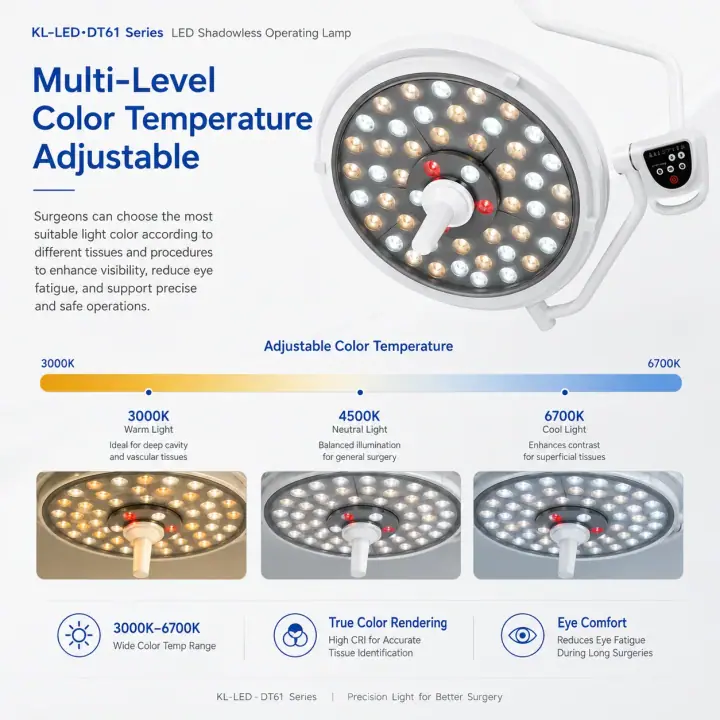
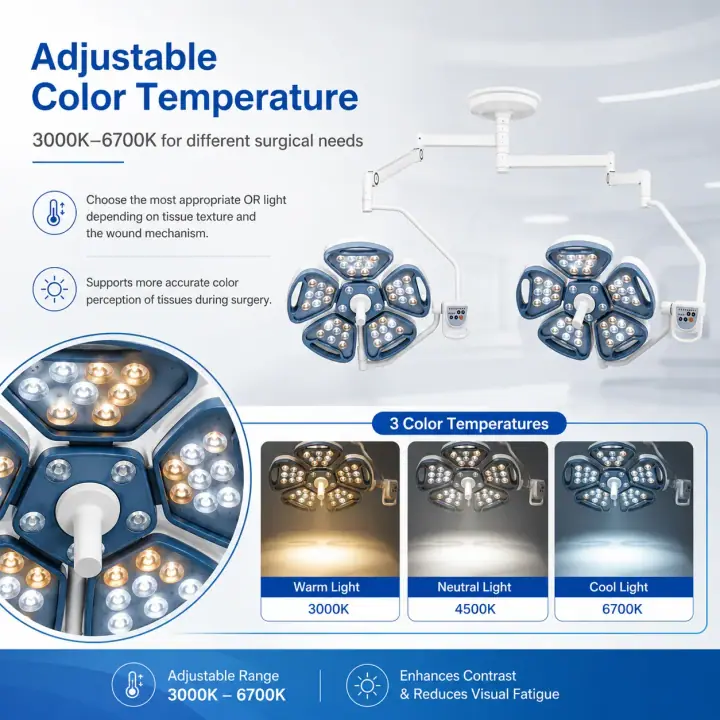
| Colour temperature | 3,000–6,700 K |
| Colour rendering Ra | 85–100 |
| Total irradiance | Limited, to avoid tissue heating |
In combination, these values describe a light that is bright enough, wide enough, deep enough and cool enough. Background on the units: lux vs lumens.
Typical lux by room and procedure
| Setting | Typical central illuminance at 1 m | Example Keling model |
|---|---|---|
| Major general / orthopaedic / cardiac OR | 140,000–160,000 lux, often two heads | KL-LED-DT6I — 160,000 lux per dome |
| Standard OR, single head | 120,000–160,000 lux | KL-LED-STZ5 |
| Day surgery, ambulatory OR | 80,000–120,000 lux | KL-LED-SZ4 — 40,000–120,000 lux |
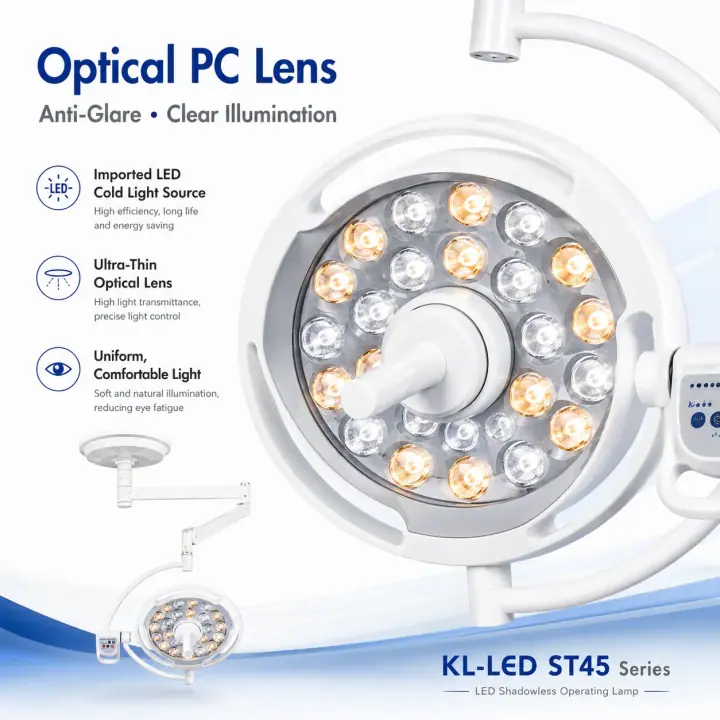
| Dental implant, minor surgery | 60,000–100,000 lux | KL-LED-ST45 — ≥ 80,000 lux |
| Emergency, procedure room | 40,000–80,000 lux | KL05L-LED — 90,000 lux |
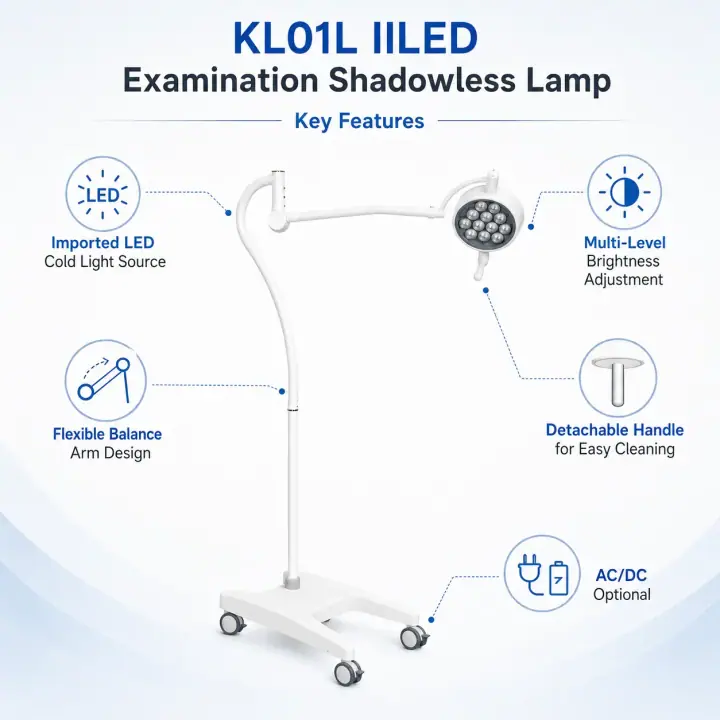
| Examination, gynaecology, ENT | ~30,000–80,000 lux | KL01L-IILED — ≥ 60,000 lux |
Ranges are typical tender values, not regulatory minimums. Local guidelines and clinical teams have the final say.
Why the top number is not the whole story
Field size (D10 and D50)
A light with very high lux in a tiny spot can be worse than a slightly dimmer light with a wide, even field. Check that D50 is a healthy fraction of D10 — that means the light falls off gradually rather than abruptly.
Depth of illumination
Deep cavities need light that stays bright as the surgeon works below the focal plane. Keling ceiling LED lights such as the STZ4/STZ5 specify L1+L2 = 150 cm.
Shadow dilution
Lux is measured with nothing in the way. In real surgery, heads and hands block part of the light. Multi-source LED domes and multi-reflector lamps are designed to fill those shadows — see shadowless lamps explained.
Heat
Radiant heat rises with illuminance. LED lights keep the heat-to-light ratio low (≤ 3.2 mW/m²·lx on Keling LED models), so high lux does not mean a hot wound.
Endo mode and adjustable intensity
During laparoscopy the surgeon watches monitors; full surgical light would wash them out. Endo mode drops the light to a low level — 10,000–15,000 lux on Keling LED models — enough to handle instruments. All Keling LED lights also have stepped or stepless intensity control, so 160,000 lux is the maximum, not the only setting.
Ambient operating room lighting
The surgical light illuminates the wound; the room still needs general lighting for the team, the anaesthetist and the scrub nurse. Guidelines commonly cite around 1,000 lux or more for general OR lighting, much lower than the surgical field to limit contrast and eye fatigue. See our operating room lights guide.
How to write lux into a tender
- Central illuminance at 1 m: "≥ 140,000 lux, adjustable" (or your clinical target).
- D10 and D50 ranges, plus depth L1+L2.
- Endo mode illuminance if minimally invasive surgery is performed.
- CCT range and Ra / R9.
- Compliance with IEC 60601-2-41 and test report reference.
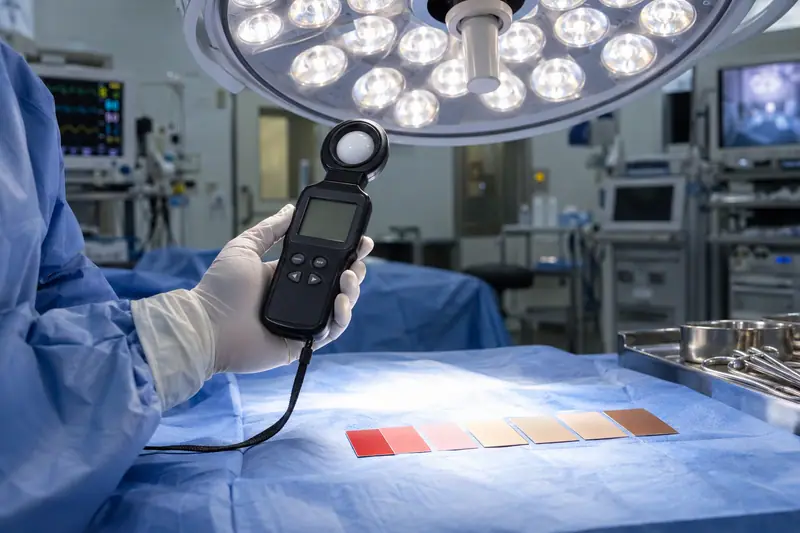
- Measurement method for site acceptance — see how to use a lux meter.
Send us your room list and we will propose models that meet each lux requirement: request a quote.
Frequently asked questions
How many lux does a surgical light need?
IEC 60601-2-41 requires a surgical luminaire to deliver a central illuminance between 40,000 and 160,000 lux at 1 m. Most modern LED main lights for general surgery are specified at the upper end, around 140,000–160,000 lux.
How many lux for minor surgery?
Minor surgery and procedure lights are commonly specified from about 40,000 to 100,000 lux at 1 m. The Keling KL-LED-ST45 for dental implant and minor surgery delivers at least 80,000 lux.
How many lux does an examination light need?
Examination lights are not surgical luminaires and typically deliver roughly 20,000–80,000 lux at their working distance. Keling examination lights range from at least 12,000 lux (KL01L-IP) to at least 80,000 lux (KL01L-IILEDTR) at 1 m.
What is the general lighting level in an operating room?
Ambient (general) operating room lighting is far lower than the surgical field — national guidelines commonly cite around 1,000 lux or more. Always follow the guideline that applies in your country.
Is more lux always better?
No. Excessive illuminance increases glare, reflected light and radiant heat at the wound. The goal is enough light with adjustable intensity, good field size, depth and colour rendering.
What is endo mode?
Endo mode is a low-light setting used during laparoscopic or endoscopic procedures so the surgical team can see the room and instruments without washing out the video monitors — typically around 10,000–15,000 lux on Keling LED lights.