How to Choose a Surgical Light: Lux, D10/D50, Depth, CRI and Colour Temperature Explained
Surgical light specifications explained: central illuminance, D10/D50, depth of illumination, Ra/R9, colour temperature and heat-to-light ratio.

A surgical-light datasheet contains a dozen numbers. Only a few decide whether the light will perform in your theatre. This guide translates the key specifications — with reference values from the international standard IEC 60601-2-41 and real Keling Medical datasheets — so you can compare offers on equal terms.
1. Central illuminance (Ec) — how bright?
Central illuminance is measured in lux at 1 m from the light-emitting surface, at the centre of the light field. IEC 60601-2-41 sets the acceptable range at 40,000–160,000 lux.
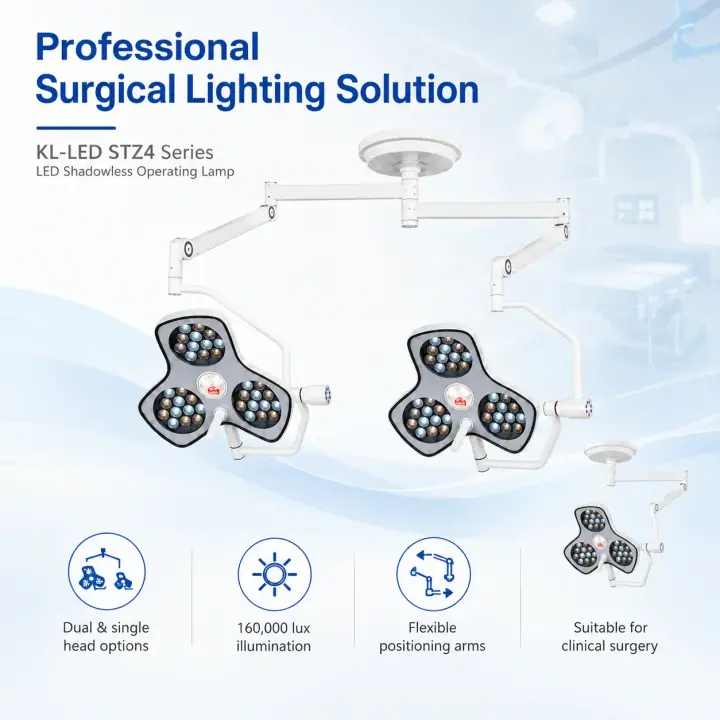
- Main operating theatres: 120,000–160,000 lux per head. The Keling KL-LED-STZ4 and KL-LED-DT6I deliver 160,000 lux.
- Minor surgery, dental implantology: around 80,000 lux, as with the KL-LED-ST45.
- Examination: 30,000–80,000 lux, e.g. the KL01L-IILEDTR.
More is not always better: a light that is always dimmed to 60% wastes budget. Ask for stepless dimming so the team can match brightness to the procedure.
2. Light-field diameter — D10 and D50
Light falls off from the centre of the field. Two diameters describe the shape:
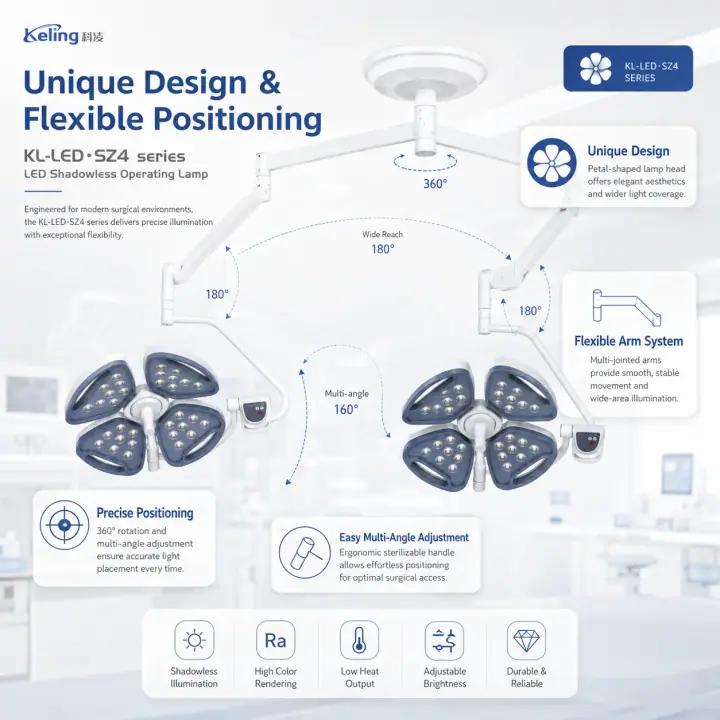
- D10 — diameter where illuminance drops to 10% of Ec. This is the usable working area. Keling ceiling LED heads specify 180 ± 40 mm (petal domes) to 220 ± 40 mm (round domes).
- D50 — diameter where illuminance drops to 50% of Ec. Keling heads specify 110 ± 35 mm.
A focus adjustment (manual or electric) changes the field diameter — for instance 10–28 cm on the STZ series and 20–30 cm (electric) on the DTR78.
3. Depth of illumination (L1+L2)
Deep cavities — abdominal, thoracic, pelvic — need light that stays bright above and below the focal plane. Depth of illumination is the distance along the beam axis, above and below the focal point, over which illuminance stays above the threshold defined in IEC 60601-2-41. Keling LED heads specify 108–150 cm; the STZ5 and DTR78 reach 150 cm.
4. Shadow dilution
A good light keeps the field lit when the surgeon's head, hands or instruments block part of the lamp. Multi-source designs — petal domes, multi-lens LED arrays, or multi-reflector hole-type heads — overlap beams from many angles. Ask for test results with one and two masks, as described in IEC 60601-2-41.
5. Colour rendering — Ra, R9 and R11
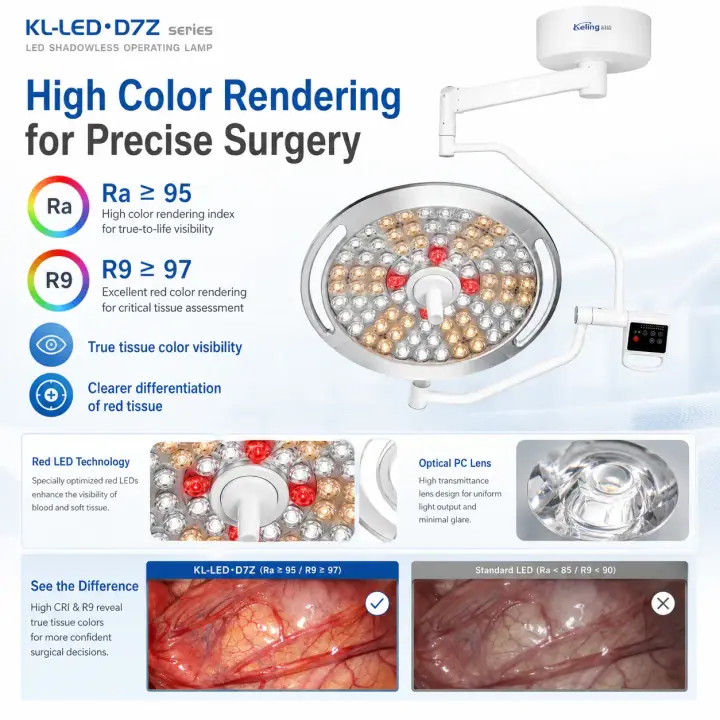
- Ra (CRI): the average of eight pastel test colours. Required range: 85–100.
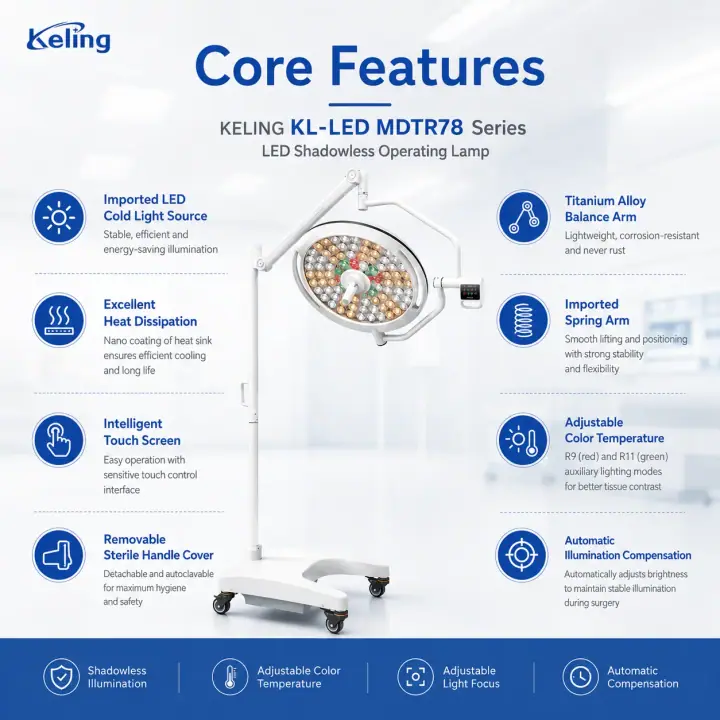
- R9: saturated red — the most relevant for blood and perfused tissue. Premium LED heads such as the KL-LED-MDTR78 specify R9 ≥ 97.
- R11: saturated green — useful for differentiating vessels and fat; the DTR78/MDTR78 specify R11 ≥ 97.
6. Colour temperature (Tc)
The standard range is 3,000–6,700 K. Adjustable-temperature lights let the team switch between warm light (less glare, less fatigue) and cool light (more contrast). Fixed-temperature models usually sit at 4,500 ± 500 K — a neutral, proven choice for general surgery.
7. Heat — irradiance and heat-to-light ratio
Radiant energy dries tissue. Compare the heat-to-light ratio in mW/m²·lx: Keling LED lamps are specified at ≤3.2, halogen lamps at <6. Lower is better.
8. Endoscopic (Endo) mode
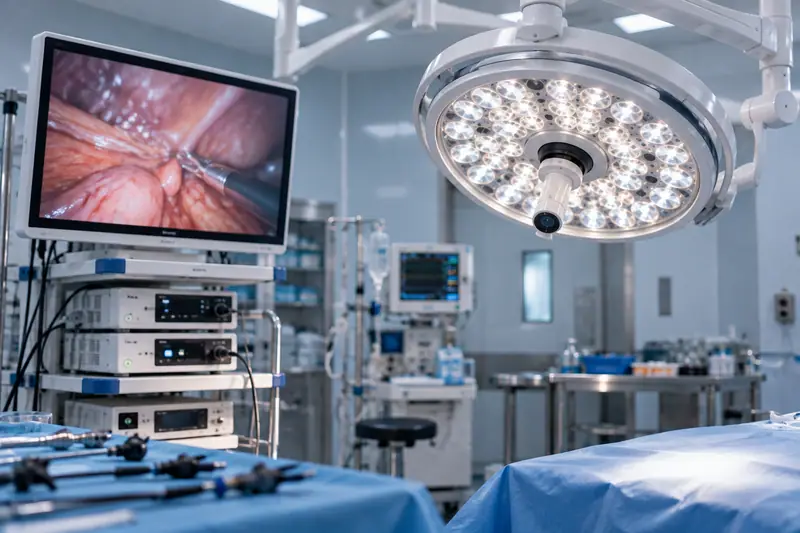
During laparoscopy the OR needs ambient light without washing out the monitor. Many LED heads have an independent low-output circuit — 10,000 lux on the STZ series, 15,000 lux on the DT6I/DTR78/MD78.
9. Mechanics and installation
- Ceiling height for suspension systems — typically 270–320 cm for Keling ceiling lights.
- Working distance — 70–140 cm.
- Balance arm — drift-free positioning; the DTR78 uses a titanium-alloy arm.
- Sterilisable handle — removable, autoclavable handles let the surgeon position the light within the sterile field.
Datasheet comparison template
| Spec | What to ask for | Keling reference (KL-LED-DTR78) |
|---|---|---|
| Ec at 1 m | 40,000–160,000 lux | 160,000 lux per dome |
| D10 / D50 | Both values, mm | 220 ± 40 / 110 ± 35 mm |
| Depth L1+L2 | ≥ 100 cm | 150 cm |
| Ra / R9 / R11 | Ra ≥ 85; R9 if possible | Ra ≥ 85, R9 ≥ 97, R11 ≥ 97 |
| Tc | 3,000–6,700 K | 3,000–6,700 K adjustable |
| Heat-to-light | mW/m²·lx | ≤ 3.2 |
| Endo mode | lux | 15,000 lux |
| LED life | hours | 50,000 h |
Use our product finder to filter by illuminance, mounting type and features, or send us your tender specification for a compliance check against Keling models.
Frequently asked questions
How many lux does a surgical light need?
IEC 60601-2-41 requires a surgical luminaire's central illuminance at 1 m to be between 40,000 and 160,000 lux. Main operating theatres typically specify 120,000–160,000 lux per lamp head; minor surgery and examination lights work well at 30,000–80,000 lux.
What is D10 and D50 on a surgical light?
D10 is the diameter of the light field where illuminance falls to 10% of the central value; D50 is where it falls to 50%. A larger D10 gives a wider working area; a D50 that is a healthy fraction of D10 indicates an even field without a harsh hotspot.
What CRI should a surgical light have?
The colour rendering index (Ra) should be between 85 and 100 under IEC 60601-2-41. For specialties where tissue differentiation is critical, also check R9 (saturated red) — premium LED heads reach R9 ≥ 97.
What colour temperature is best for surgery?
The standard range is 3,000–6,700 K. Around 4,500 K is a neutral default. Adjustable lights let surgeons choose warmer light to reduce fatigue or cooler light to increase tissue contrast.