Surgical Camera vs Endoscopy Camera: Choosing Video Systems for the Operating Room
Surgical light cameras, endoscopy cameras, surgical head cameras and surgical monitors compared — what each records, resolution, interfaces and how to build an operating room camera system.

Video has become standard equipment in the operating room — for teaching, documentation, remote consultation and, in laparoscopy, for performing the surgery itself. But "surgical camera" can mean very different devices. This guide compares them and explains how to build an operating room camera system.
In one line: an endoscopy camera sees inside the patient through a scope; a surgical light camera sees the open field from above; a head camera sees what the surgeon sees. Monitors display all three.
Types of surgical cameras
| Camera type | Mounted on | Shows | Main uses |
|---|---|---|---|
| Endoscopy / laparoscopy camera | Endoscope eyepiece or integrated scope | Inside body cavities | Performing MIS, arthroscopy, ENT, urology |
| Surgical light camera | Centre of the light head or light arm | Open operative field from above | Documentation, teaching, telemedicine |
| Room / ceiling camera | Ceiling or wall | Whole room overview | Workflow, team view, telepresence |
| Surgical head camera | Headband or loupes | Surgeon's point of view | Dental, plastic, close work |
| Microscope / exoscope camera | Surgical microscope or exoscope arm | Magnified field | Neuro, ENT, ophthalmic |
Endoscopy camera systems
An endoscopy camera system consists of a camera head, camera control unit, light source (LED or xenon), endoscope and surgical monitor, often on a tower. HD and 4K systems are standard; some use fluorescence imaging. "Wireless" and "WiFi endoscope cameras" sold online are mostly inspection devices, not medical systems — for clinical use choose a registered medical device.
Surgical light camera systems
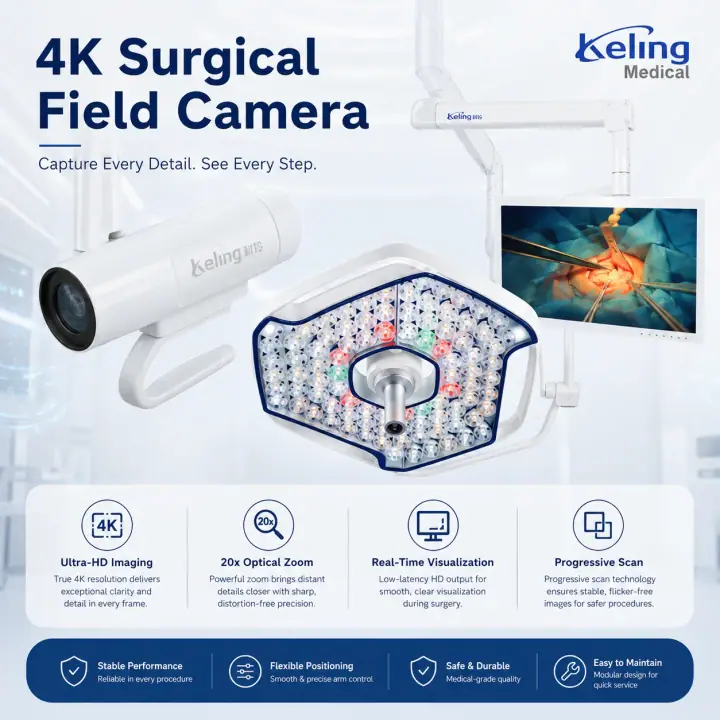
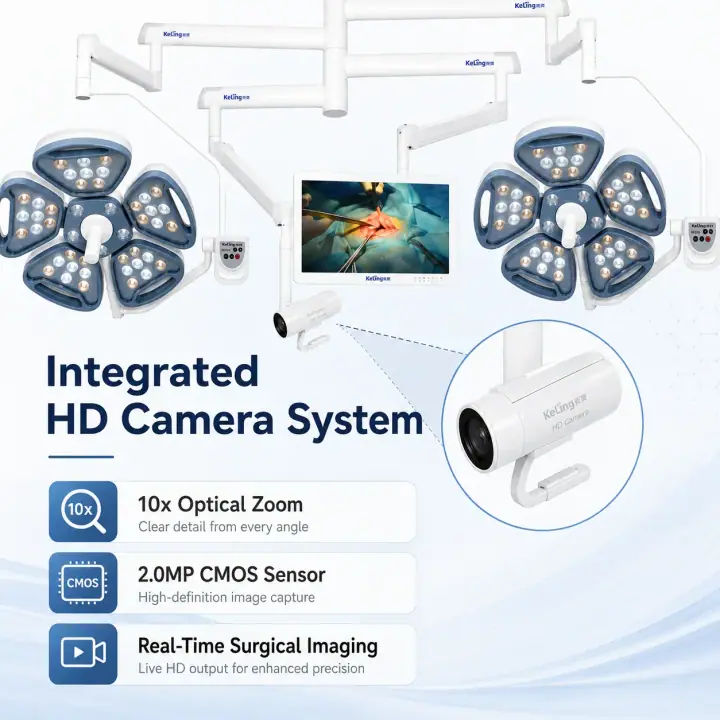
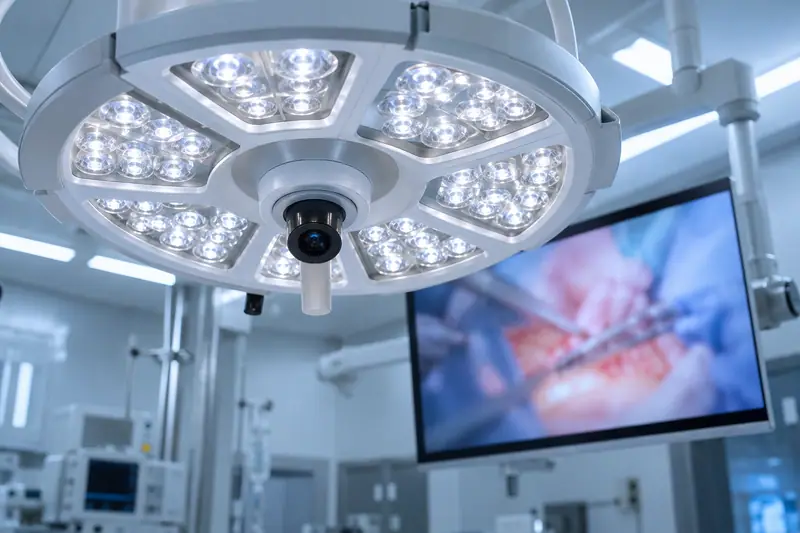
A camera in the light head moves with the light and is always aimed at the illuminated field — the most practical way to record open surgery. Keling offers two systems:
| Feature | KL-LED-STZ5 camera system | KL-LED-STR78 / DTR78 camera system |
|---|---|---|
| Camera | MH-DFC210-SR HD | MH-DFC210-SR 4K |
| Sensor | 1/2.8" progressive scan CMOS | 1/2.8" progressive scan CMOS |
| Optical zoom | 10× (4.7–47 mm) | 10× (4.7–47 mm) |
| Output | 3G-SDI (MCX) | 3G-SDI (MCX) |
| Frame rate | 1080p at 25/50 fps (PAL), 30/60 fps (NTSC) | 1080p at 25/50 fps (PAL), 30/60 fps (NTSC) |
| Control | IR remote, RS-485 | IR remote, RS-485 |
| Light | Dual five-petal LED domes | Single or dual LED heads |
More background in surgical light camera systems.
Surgical monitors and displays
- Size and resolution matched to viewing distance — 27–32" on pendant arms, 55" + wall displays for teaching.
- Medical-grade displays with appropriate certification, sealed fronts for cleaning.
- Inputs matching the cameras (SDI, HDMI, DVI, IP).
- Low latency for endoscopic surgery — the surgeon operates from the screen.
- Mounting on light or pendant arms, in the surgeon's line of sight.
Building an operating room camera system
- Define uses: performing MIS, recording, teaching, remote proctoring.
- Choose sources: endoscopy camera, light camera, room camera.
- Route video: SDI/IP routing to monitors, recorder and network.
- Record: medical recorder or integration system with PACS export.
- Govern: consent, data protection and retention policy.
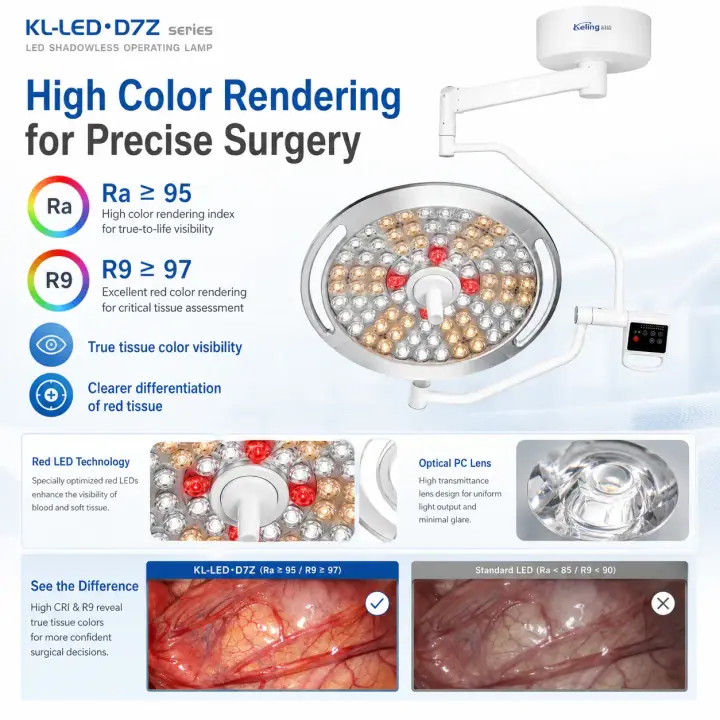
- Light correctly: high Ra/R9 and stable colour temperature give true colours on video — see what CCT means.
Light settings for video
- Reduce glare by lowering intensity slightly; cameras saturate before eyes do.
- Use endo mode during laparoscopy so room light does not wash out monitors.
- Keep the same CCT throughout a recording.
Need a light with built-in camera? Request the camera system datasheets.
Frequently asked questions
What is the difference between a surgical camera and an endoscopy camera?
An endoscopy camera attaches to an endoscope or laparoscope and shows the inside of the body during minimally invasive surgery. A surgical (field) camera — often built into the surgical light — records the open operative field from above for documentation, teaching and telemedicine.
What is a surgical light camera?
A surgical light camera is a high-definition camera mounted in the centre of a surgical light head or on its arm. Because it moves with the light, it always points at the illuminated field. Keling's camera systems use the MH-DFC210-SR camera with 10× optical zoom and 3G-SDI output.
Can a surgical light camera replace an endoscopy camera?
No. A surgical light camera records the outside of the operative field; laparoscopic and endoscopic procedures still need an endoscopy camera system with its own light source and scope.
What resolution should an operating room camera have?
Full HD (1920 × 1080) is the minimum for documentation and teaching; 4K systems are increasingly used for detail and large displays. Check frame rate (50/60 fps for smooth motion), optical zoom and output interface.
What is a surgical head camera?
A camera worn on the surgeon's head or loupes that records the surgeon's point of view. It is useful for close, angled work but moves with every head movement, so footage is less stable than from a light-mounted camera.