Surgical Lights with Integrated HD and 4K Cameras: What Hospitals Should Know
How surgical light camera systems work, which specs matter (sensor, zoom, 3G-SDI output, frame rate) and what to plan before installation.

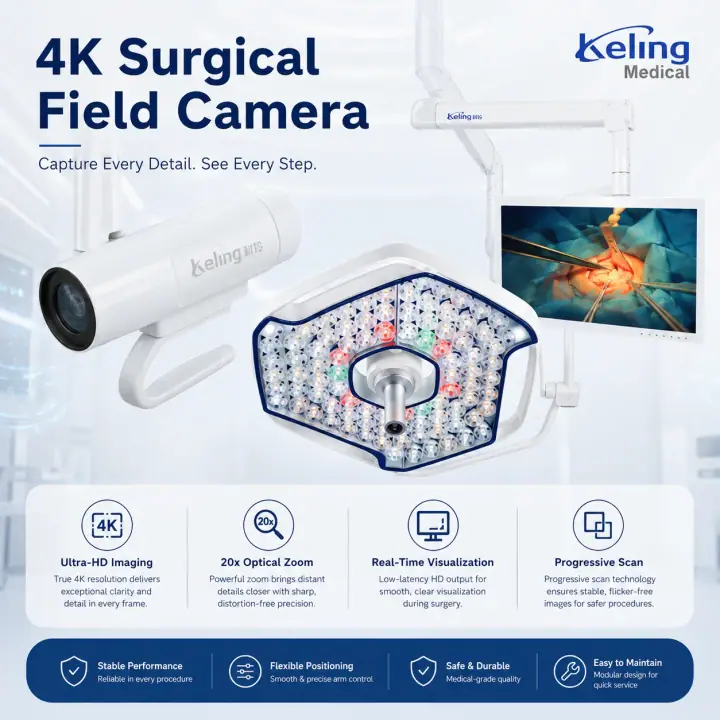
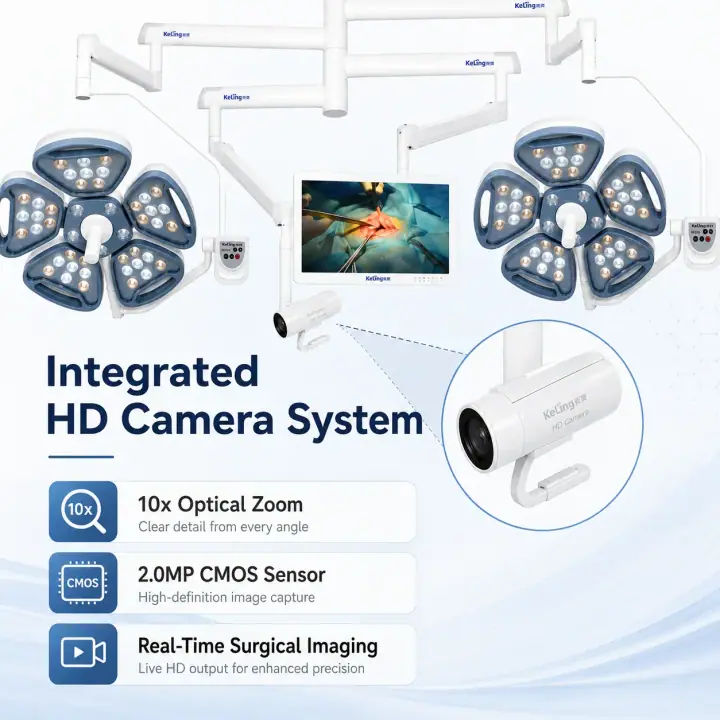
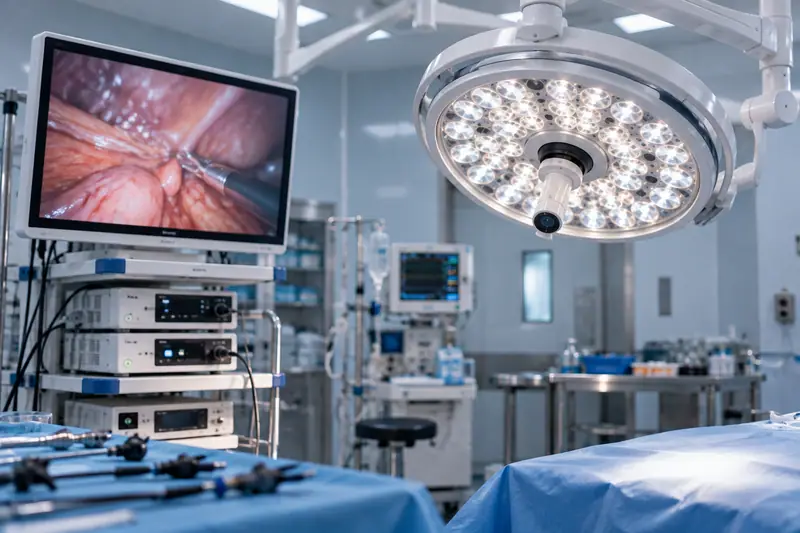
Operating-room video used to require a separate boom-mounted camera. Today the camera can sit inside the surgical light system, aligned with the light beam and therefore with the surgeon's line of sight. Keling offers two such systems: the KL-LED-STR78 / DTR78 Camera System and the KL-LED-STZ5 Camera System.
Why integrate the camera with the light?
- Same viewpoint as the surgeon — the camera looks down the beam, so the field is always lit and framed.
- One ceiling axis — fewer booms competing for ceiling space and laminar airflow.
- Repositioning is natural — when the nurse moves the light, the camera follows.
Where hospitals use it
- Teaching and residency programmes — live transmission to seminar rooms or the gallery.
- Telemedicine and remote proctoring — a specialist guides a procedure from another site.
- Documentation — recordings for patient records, quality review and medico-legal purposes.
- Team awareness — scrub nurses and anaesthetists see the field on a wall monitor.
Specifications that matter
| Specification | Why it matters | Keling MH-DFC210-SR camera |
|---|---|---|
| Sensor | Low-light performance, noise | 1/2.8" progressive-scan CMOS |
| Optical zoom | Detail without moving the light | 10× (4.7–47 mm) |
| Aperture | Brightness and depth of field | F1.6–F3.0 |
| Output | Compatibility with recorders/routers | 3G-SDI, MCX female |
| Resolution / frame rate | Smoothness of motion | 1920 × 1080 at 25/50 fps (PAL), 30/60 fps (NTSC) |
| Focus | Hands-free operation | Auto / semi-auto / manual |
| Control | Integration with OR systems | RS-485 + infrared remote |
| Strong-light suppression | Prevents blown-out highlights under 160,000 lux | Supported |
| Image freeze | Discuss a frame during surgery | Supported |
| Power | Installation planning | 12 VDC, 1.5 A; 5.5 W |
Installation checklist
- Video path: where will the SDI signal go — a recorder, an OR integration system, a hospital network encoder?
- Cable routing: through the suspension axis to the wall or ceiling distribution box.
- Monitor placement: on the light's monitor arm or a separate pendant.
- Data protection: agree recording, storage and consent policies with the hospital's information-governance team before go-live.
- Training: make sure circulating staff can zoom, focus and freeze from the remote.
Choosing between the two Keling systems
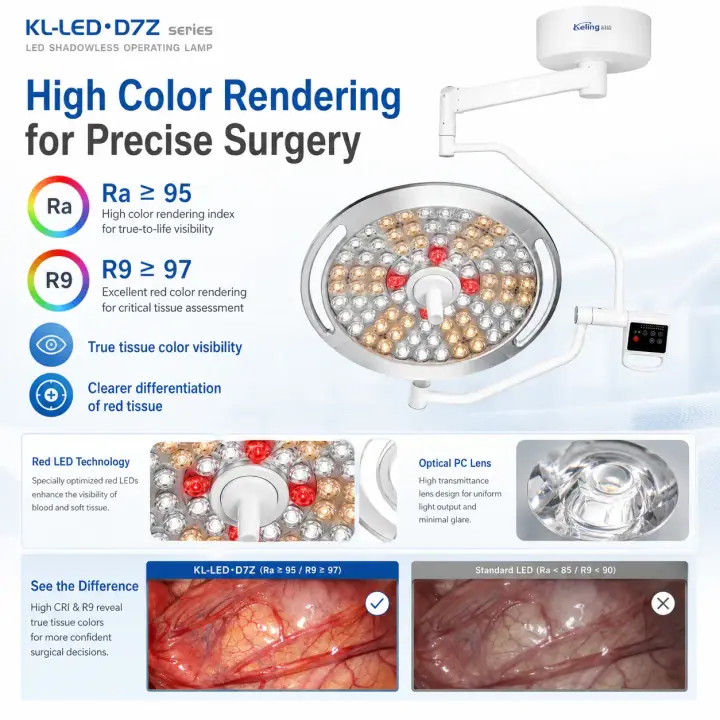
- Pick the STR78/DTR78 camera system when you need round-dome heads with R9/R11 ≥ 97 tissue rendering, electric focus and up to 228 LEDs across two domes.
- Pick the STZ5 camera system for the five-petal-dome optical design with 45 computer-arranged LEDs per head.
Both deliver 160,000 lux per head. Compare them side by side or request a configuration.
Frequently asked questions
What is a surgical light camera system?
It is a surgical light with a video camera mounted in the centre of the lamp head or on its own arm, capturing the surgeon's view of the operative field for live display, recording, teaching or telemedicine.
What output does the Keling surgical camera use?
The MH-DFC210-SR camera used in Keling KL-LED-STR78/DTR78 and KL-LED-STZ5 camera systems outputs 1920 × 1080 video over 3G-SDI (MCX female connector) at 25/50 fps (PAL) or 30/60 fps (NTSC), with an RS-485 control interface.
Does the camera have optical zoom?
Yes. The camera offers 10× optical zoom (focal length 4.7–47 mm, aperture F1.6–F3.0) with auto, semi-auto and manual focus.