Operating Room Lights: A Buyer's Guide to Surgical Operating Room Lighting
A practical guide to operating room lights: surgical lights vs general OR lighting, LED operating room lights, ceiling and mobile surgery lamps, key specifications and a buying checklist.

Operating room lights decide how well a surgical team can see — for hours at a time. Choosing them means balancing illuminance, shadow control, colour rendering, heat, ergonomics, room layout and budget. This guide is written for hospital planners, biomedical engineers and distributors comparing surgical operating room lights.
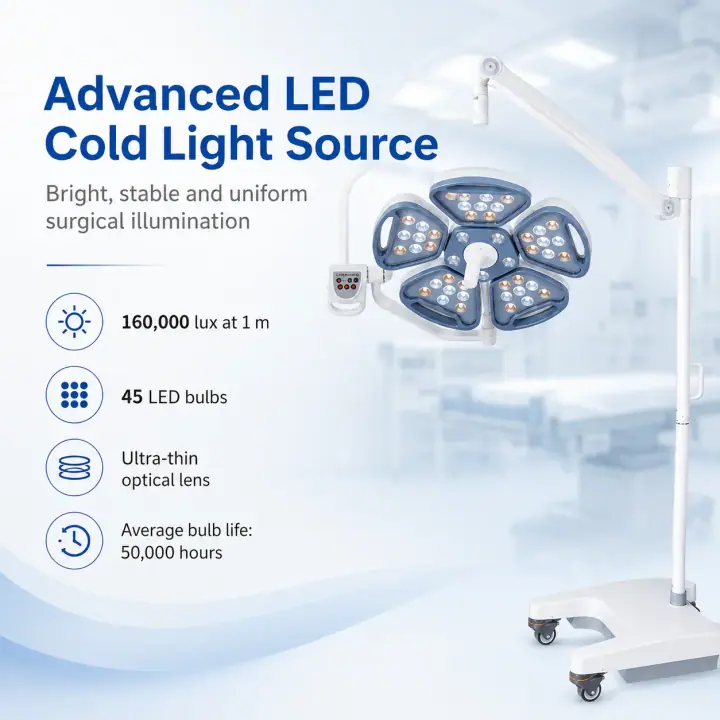
Key point: an operating room has two lighting systems — the surgical light focused on the wound (up to 160,000 lux), and the general room lighting for everything else. They are specified separately.
The two layers of OR lighting
| Aspect | Surgical light | General OR lighting |
|---|---|---|
| Purpose | Light the operative field | Light the room, team and equipment |
| Typical level | 40,000–160,000 lux at 1 m | Commonly around 1,000 lux or more |
| Standard | IEC 60601-2-41 | National building / hospital guidelines |
| Form | Focused lamp heads on arms | Sealed, cleanable ceiling luminaires |
This guide focuses on the surgical light. For room lighting see the hospital lighting guide.
Types of operating room lights
By mounting
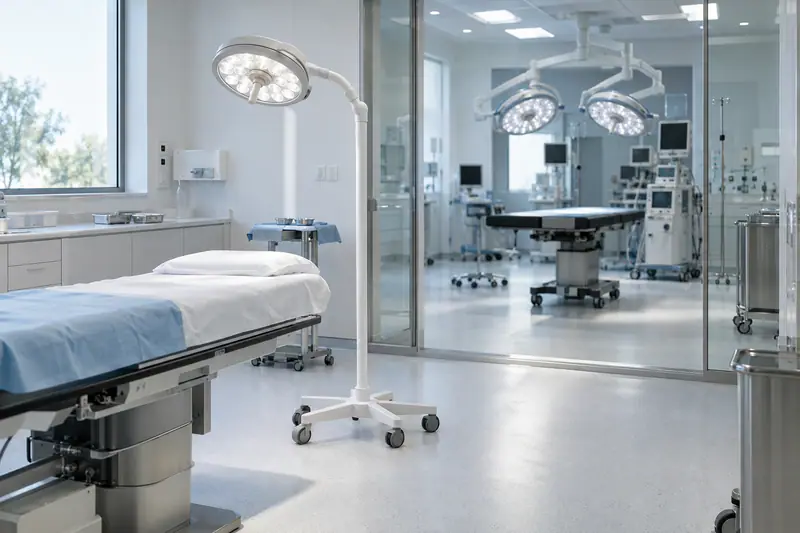
- Ceiling-mounted — the standard for main ORs; one or two heads (and sometimes a monitor arm) on one central axis. See ceiling mounted surgical light installation.
- Mobile (floor-standing) — on a wheeled base; for procedure rooms, back-up, or where the ceiling can't take a mount. See portable surgical lights.
- Wall-mounted — mainly examination and minor procedure lights.
Read the head-to-head comparison: ceiling vs mobile surgical lights.
By light source
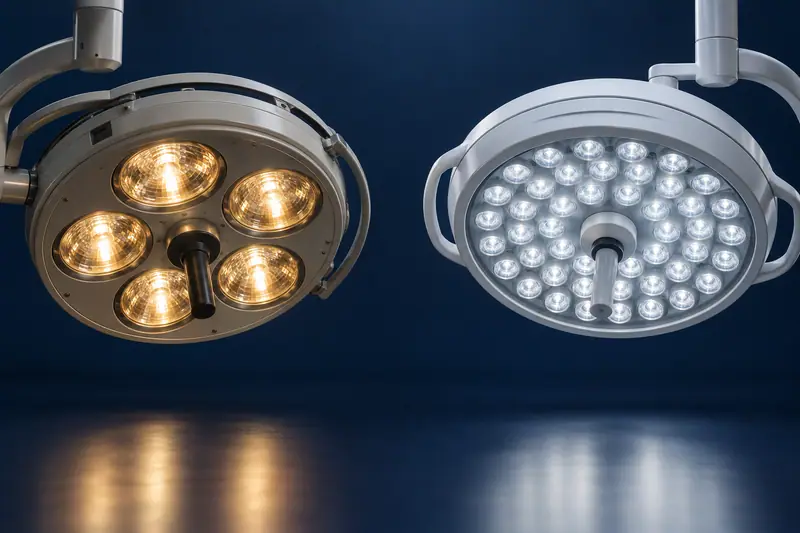
- LED operating room lights — today's default: low heat, long life, adjustable CCT.
- Halogen operating lamps — lower purchase price, simple bulb replacement; see LED vs halogen and replacing halogen with LED.
By lamp-head design
- Multi-petal LED domes (four or five petals).
- Multi-reflector / hole-type heads (five, six, nine or twelve holes).
- Integrated camera heads for recording and teaching — see surgical light camera systems.
Specifications that matter
| Specification | What to look for |
|---|---|
| Central illuminance (Ec) at 1 m | 140,000–160,000 lux for main ORs, adjustable |
| Field diameter D10 / D50 | Adjustable field, even fall-off |
| Depth of illumination L1+L2 | 100–150 cm for deep cavities |
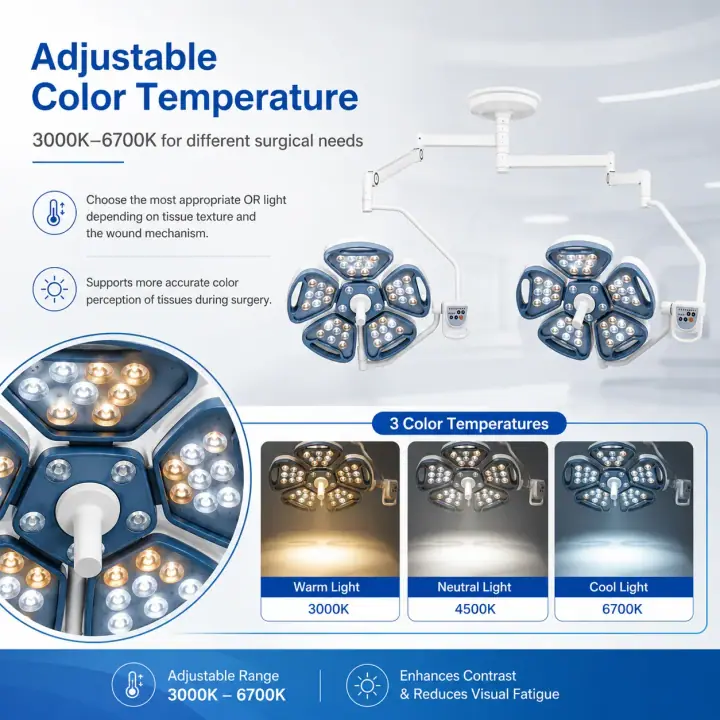
| Colour temperature | 3,000–6,700 K adjustable, or ~4,500 K fixed |
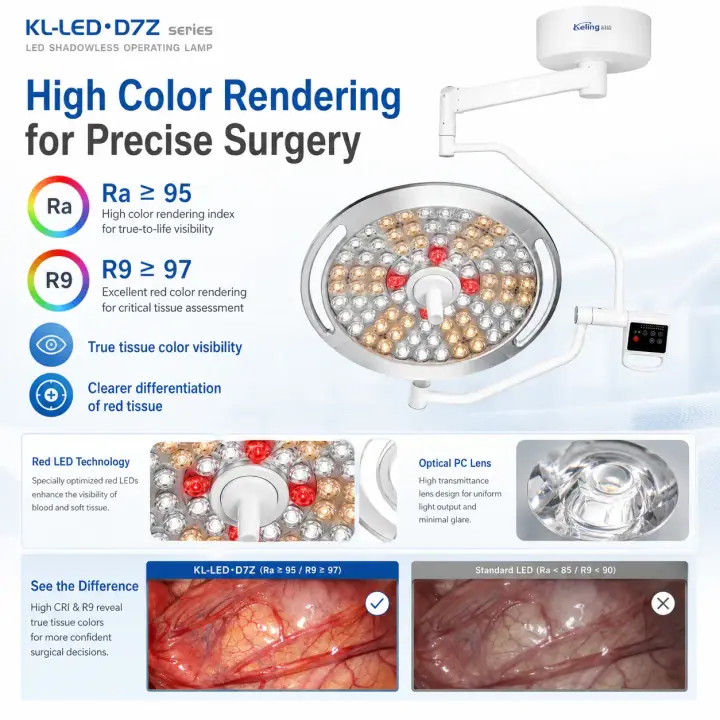
| Colour rendering | Ra ≥ 85; R9 ≥ 90 for tissue contrast |
| Heat-to-light ratio | As low as possible (≤ 3.2 mW/m²·lx on Keling LED) |
| Endo mode | Low setting for laparoscopy |
| LED life | ~50,000 hours |
| Arm movement | Smooth positioning, stays in place, sterilisable handle |
Background reading: surgical light lux requirements, what CCT means, how to choose a surgical light.
Matching lights to rooms
| Room | Recommended configuration | Keling examples |
|---|---|---|
| Major / hybrid OR | Dual-head LED, camera option | KL-LED-DTR78, KL-LED-DT6I |
| General OR | Single or dual LED dome | KL-LED-STZ5, KL-LED-STZ4 |
| Day surgery / procedure room | Single LED head or mobile | KL-LED-SZ4, KL-LED-MSTZ5 |
| Dental / minor surgery | Compact LED with anti-curing filter | KL-LED-ST45 |
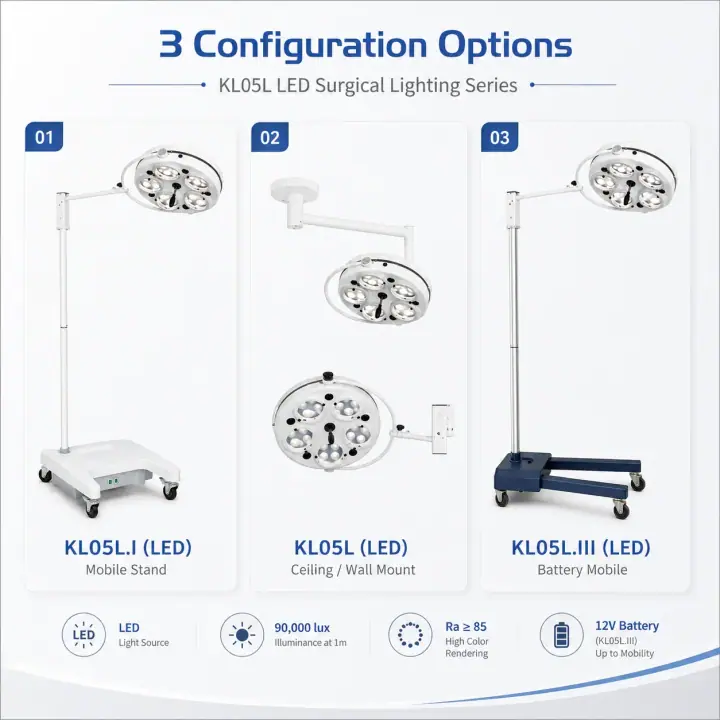
| Budget or field OR | Multi-reflector LED, battery option | KL05L-LED |
Browse the full range: ceiling LED surgical lights, mobile LED surgical lights, multi-reflector surgical lights.
Buying checklist
- Room list with procedure types and ceiling heights.
- Required illuminance, field size, depth and CRI per room.
- Mounting type, number of heads, monitor/camera arms.
- Power supply (voltage, frequency) and back-up power needs.
- Certificates for registration (CE, ISO 13485, FDA, local).
- Installation drawings and anchor-plate requirements.
- Spare parts, training and warranty terms.
- Delivery time, packaging and Incoterm — see shipping medical equipment internationally.
Operating room lights for sale: getting a quote
Prices depend on configuration, quantity and destination, so we quote per project rather than publishing a price list — see our surgical light price guide for the cost drivers. Send your room list and our export team will reply with a configuration and quotation.
Frequently asked questions
What are operating room lights called?
They are called surgical lights, surgical lamps, operating lights, operating theatre lights or shadowless operating lamps. All refer to the focused luminaire above the operating table, as distinct from the room's general lighting.
What type of lighting is used in operating rooms?
Two layers: a surgical light (40,000–160,000 lux at 1 m on the operative field, usually LED) and general ambient lighting from sealed ceiling fixtures. Many rooms add endo-mode or green ambient lighting for minimally invasive surgery.
Why are LED operating room lights preferred?
LED operating room lights run much cooler at the wound, last around 50,000 hours, use less energy and allow adjustable colour temperature and intensity — while matching or exceeding halogen illuminance.
How many surgical lights does an operating room need?
Most general and major surgery rooms use a dual-head system (main light plus satellite) on one ceiling mount. Minor procedure rooms often use a single head, and flexible rooms sometimes add a mobile light.
Where can I buy operating room lights?
From the manufacturer or its authorised distributors. Keling Medical manufactures ceiling, mobile and wall-mounted operating room lights in China and supplies hospitals, distributors and government tenders worldwide.