Shipping Medical Equipment Internationally: Packing, Incoterms, Documents and Supply Chain Tips
How to ship medical equipment internationally: sea vs air freight, Incoterms, export packing for surgical lights, customs documents, insurance and building a resilient medical supply chain.

A surgical light that arrives damaged or stuck in customs is a project delay — and in a tender, a penalty. This guide explains how to plan shipping medical equipment internationally, from packing to customs, and how to make your medical supply chain resilient.
Checklist: agree the Incoterm, choose sea or air, specify export packing, insure the cargo, prepare documents for your regulator, and plan buffer time.
Sea freight or air freight?
| Aspect | Sea freight (FCL / LCL) | Air freight |
|---|---|---|
| Best for | Projects, multiple lights, tables | Urgent spares, single units, samples |
| Cost | Low per unit | High per kg |
| Transit | Weeks | Days |
| Handling risk | Fewer handlings with FCL | More handling, smaller packages |
Many projects ship the main order by sea and urgent spare parts by air or courier.
Incoterms for medical equipment
| Incoterm | Seller's responsibility | Good for |
|---|---|---|
| EXW | Goods ready at factory | Buyers with strong China forwarders |
| FOB (e.g. FOB Shanghai) | Delivered on board at origin port | Buyers who control freight |
| CFR / CIF | Freight (+ insurance for CIF) to destination port | Buyers wanting a simple landed-at-port price |
| DAP | Delivered to named place, duties unpaid | Turnkey delivery without import formalities |
| DDP | Delivered, duties paid | Rare for medical devices due to import licensing |
Keling's export company in Shanghai quotes on the Incoterm you request. Compare quotes on the same basis — see the price guide.
Export packing for surgical lights
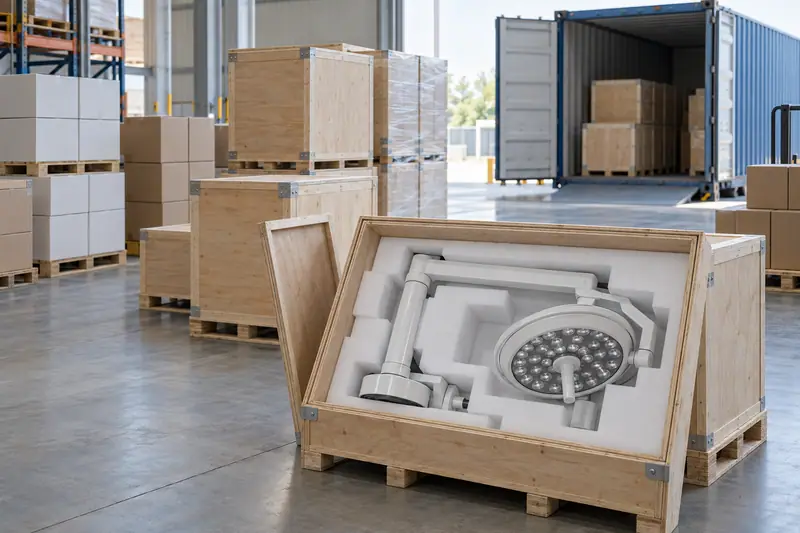
- Separate packages for lamp heads, arms, central axis and accessories.
- Foam-fitted cartons for heads; wooden crates for long arms and ceiling parts.
- ISPM 15 heat-treated or fumigated wood for international shipments.
- Orientation, fragile and moisture labels; desiccant for humid routes.
- Clear marking with project name, room number and package count — it saves days on site.
- Palletise and strap for container loading.
Documents
| Document | Purpose |
|---|---|
| Commercial invoice | Customs value |
| Packing list | Contents, weights, dimensions |
| Bill of lading / air waybill | Title and carriage |
| Certificate of origin | Duty rates, trade agreements |
| Insurance certificate | Cargo cover (CIF or buyer's policy) |
| CE, ISO 13485, free-sale certificate | Device registration and customs |
| Import permit / registration | Required in many countries |
| Pre-shipment inspection certificate | Required in some markets |
Start registration early — it often takes longer than production. See how to become a medical equipment distributor.
Insurance and damage
- Insure cargo for at least the invoice value plus freight.
- Inspect crates on arrival before signing; photograph damage.
- Report damage to the carrier and insurer promptly.
Building a resilient medical supply chain
- Forecast tender and replacement demand; place orders early.
- Keep buffer stock of fast-moving models and spare parts.
- Consolidate shipments to cut freight cost per unit.
- Use two routes (sea + air) for critical spares.
- Align production slots with your manufacturer — see sourcing surgical lights from China.
On arrival
- Customs clearance with your broker.
- Inland transport to the site or warehouse.
- Unpacking and incoming inspection.
- Installation — see ceiling surgical light installation.
- Commissioning and acceptance.
Ask for packing dimensions and a shipping quote with your next RFQ.
Frequently asked questions
How is medical equipment shipped internationally?
Usually by sea freight in full (FCL) or shared (LCL) containers for larger orders and by air freight for urgent or small shipments. Equipment is export-packed in cartons or wooden crates, insured, and shipped under an agreed Incoterm with commercial invoice, packing list and certificates.
Which Incoterm is best for importing medical equipment?
FOB (seller delivers on board at the port of loading) gives buyers control of freight; CIF or CFR (seller pays freight to the destination port) is simpler for buyers without a forwarder; DAP or DDP put more responsibility on the seller. Choose based on your forwarding capability and import rules.
What documents are needed to import medical equipment?
Typically a commercial invoice, packing list, bill of lading or air waybill, certificate of origin, insurance certificate, and device certificates or registration documents (e.g. CE, ISO 13485, free-sale certificate). Some countries require pre-shipment inspection or import permits.
How are surgical lights packed for export?
Lamp heads, arms and ceiling components are packed separately in protective foam inside strong export cartons or fumigated / heat-treated wooden crates (ISPM 15), with shock and orientation labels, and palletised for container loading.
How long does shipping medical equipment from China take?
Sea freight transit times vary widely by destination and route, from about a week to nearby Asian ports to several weeks for Africa, Europe or South America. Air freight takes a few days. Add production, customs and inland delivery time.