Choosing a Surgical Light Manufacturer or OEM Medical Device Partner
How to evaluate a surgical light manufacturer, supplier or medical device OEM / contract manufacturing partner: certifications, quality system, production capacity, testing, OEM labelling and audit checklist.

Whether you are a hospital buying direct, a distributor adding a product line, or a brand looking for medical device contract manufacturing, the choice of surgical light manufacturer determines product quality, regulatory risk and after-sales experience for a decade or more. This guide sets out what to check.
Shortlist test: ISO 13485 certified, CE (and other market) approvals for the exact models, IEC 60601-2-41 test reports, in-house production and testing, export references, and a clear OEM/quality agreement.
Manufacturer, supplier or trading company?
| Aspect | Manufacturer | Trading company / supplier |
|---|---|---|
| Owns design and technical file | Yes | No |
| Can customise / OEM | Yes | Limited, via factory |
| Technical support | Direct from engineers | Indirect |
| Price | Factory price | Margin added |
| Product range | Focused | Broad, multi-factory |
Some manufacturers run their own export company. Keling, for example, combines Jiangsu Keling Medical Appliances Co., Ltd. (R&D and production, Yangzhou) with Shanghai Keling International Trading Co., Ltd. (sales and export). See About Keling.
What to evaluate
1. Quality system and certificates
- ISO 13485 for medical device quality management.
- CE marking for the specific models; FDA registration for the US; national registrations elsewhere.
- Test reports to IEC 60601-1, IEC 60601-1-2 (EMC) and IEC 60601-2-41 (surgical luminaires).
- Verify certificates with the issuing body. More in sourcing surgical lights from China.
2. Engineering and R&D
- In-house optical, electronic and mechanical design.
- Ability to provide datasheets with measured lux, D10/D50, depth, Ra/R9 — see surgical light lux requirements.
- Product roadmap (LED, camera integration, controls).
3. Production and capacity
- Own production base and key processes (machining, assembly, testing).
- Capacity that matches your volumes and tender peaks.
- Incoming inspection and component traceability.
Keling's production base covers about 120,000 m², with around 300 employees (40% specialised technicians) and a capacity of about 30,000 medical appliances per year.
4. Testing
- Burn-in and illuminance testing of every unit.
- Electrical safety testing.
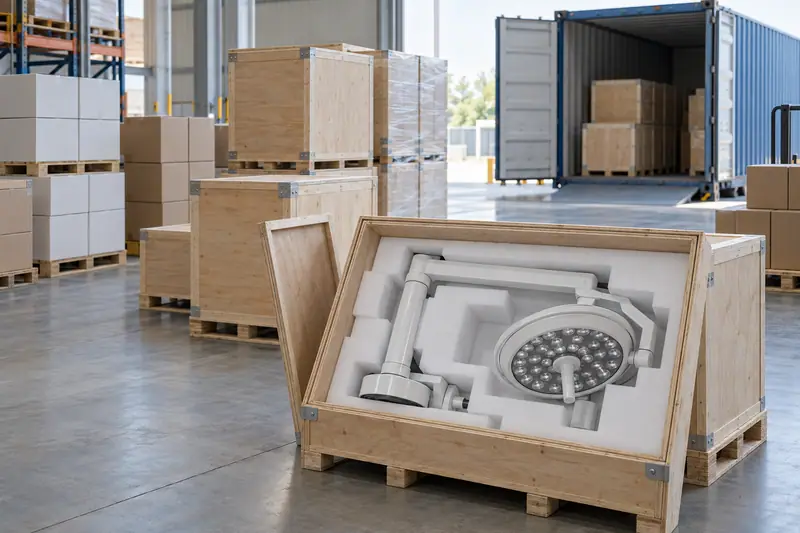
- Packaging and transport tests for export.
5. Export experience and references
- Countries served, tender history, distributor references.
- Familiarity with your registration process.
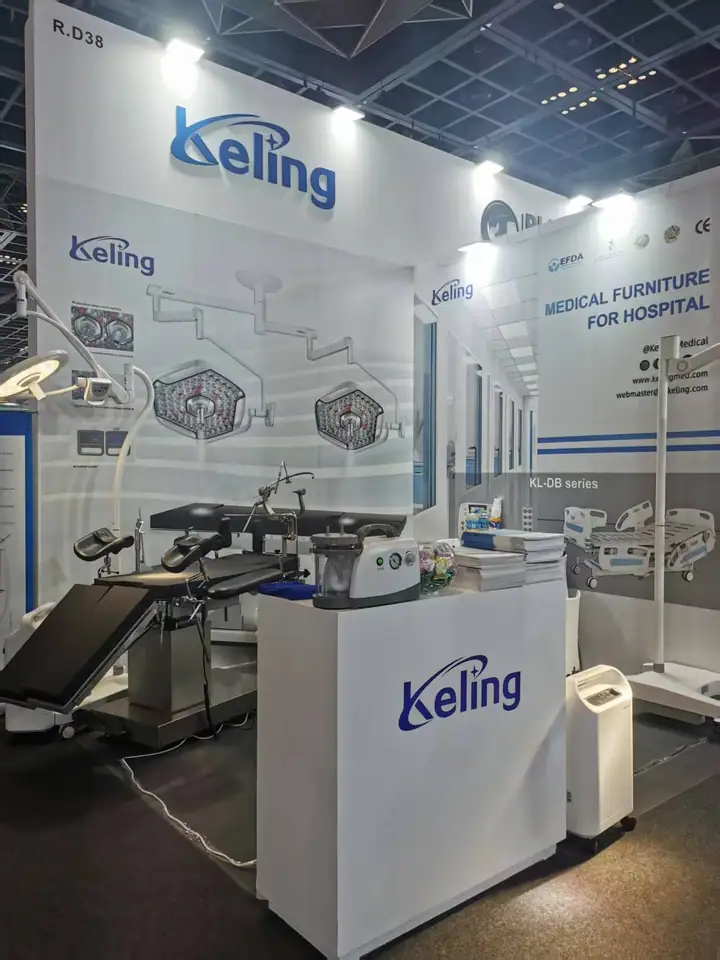
- Exhibition presence — Keling exhibits at Arab Health Dubai, CMEF Shanghai, KIHE Kazakhstan and in Saudi Arabia (projects).
6. After-sales
- Spare parts availability, service manuals, training and remote support — see maintenance and repair.
Medical device OEM and contract manufacturing
| OEM level | What changes | Typical lead time impact |
|---|---|---|
| Private label | Your logo on lamp head, labels, manual, carton | Small |
| Configuration OEM | Selected options, colours, control panel, packaging | Moderate |
| Custom development | New optics, housing or electronics | Significant; development project |
Key points for an OEM agreement:
- Who is the legal manufacturer on the label and in the technical file.
- Quality agreement: change control, complaint handling, vigilance.
- Labelling and IFU language requirements.
- Minimum order quantities and forecast.
- Intellectual property for custom designs.
Factory audit checklist
- Certificates and scope match the products you will buy.
- Production lines and test stations seen running.
- Calibration records for lux meters and safety testers.
- Traceability from serial number to components.
- Non-conformance and CAPA records.
- Finished-goods inspection and packing area.
- Sample of a complete technical file.
Why buyers choose Keling
- Founded in 1996; National High-Tech Enterprise.
- CE, ISO 9001, ISO 13485; FDA, SFDA, EFDA and Uzbekistan registrations.
- More than 40% of products sold overseas; bids won for UNICEF and Chinese government projects.
- Full range: ceiling, mobile, multi-reflector, camera and examination lights.
Frequently asked questions
How do I choose a surgical light manufacturer?
Check the quality system (ISO 13485), product certifications for your market (CE, FDA, local registration), compliance with IEC 60601-1 and IEC 60601-2-41, in-house R&D and production, test equipment, export experience, references and after-sales support. An audit or video audit of the factory is strongly recommended.
What is medical device OEM manufacturing?
In medical device OEM (original equipment manufacturer) or contract manufacturing, a manufacturer produces devices that are sold under another company's brand. The scope can range from private labelling an existing model to custom development, with responsibilities for regulatory documentation defined in a quality agreement.
What is the difference between a manufacturer and a supplier?
A manufacturer designs and produces the device and holds its technical documentation. A supplier or trading company buys from manufacturers and resells. Buying direct from the manufacturer gives better access to technical support, documentation and customisation.
Does Keling offer OEM surgical lights?
Yes. Keling Medical supplies OEM partners and distributors worldwide, with production in Yangzhou (Jiangsu Keling Medical Appliances Co., Ltd.) and export handled by Shanghai Keling International Trading Co., Ltd. Discuss labelling, packaging and documentation requirements in your RFQ.
Which certificates should a surgical light manufacturer have?
At minimum ISO 13485 for the quality management system and CE marking for Europe; FDA registration for the US; plus any national registrations required in your country. Keling holds CE, ISO 9001 and ISO 13485, with FDA, SFDA, EFDA and Uzbekistan registrations.