Ceiling-Mounted vs Mobile Surgical Lights: Which Fits Your Facility?
Ceiling-mounted or mobile surgical light? Compare installation, performance, flexibility and cost, with room-by-room recommendations.

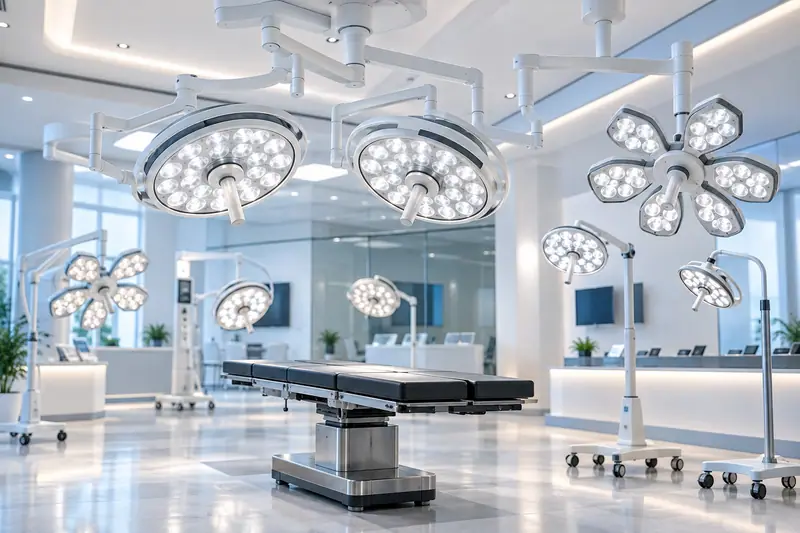
The decision between a ceiling-mounted and a mobile (floor-standing) surgical light is less about light quality — modern mobile LED lights match ceiling units on illuminance — and more about room design, workflow, infection control and budget.
The quick decision table
| Situation | Recommended | Why |
|---|---|---|
| New main operating theatre | Ceiling, double dome | Clear floor, maximum positioning freedom, two independent fields |
| Hybrid / laparoscopic OR | Ceiling with Endo mode or camera | Integrates with pendants, monitors and video |
| Procedure / minor-surgery room | Mobile single dome | No structural work; can be moved between rooms |
| Emergency department | Mobile | Flexible placement around trolleys |
| Dental implantology | Ceiling or mobile with anti-curing filter | UV/blue filter protects composite resins |
| Field hospital / unstable power | Mobile with battery | Runs through outages; no ceiling needed |
| Backup light in main OR | Mobile | Independent power and positioning |
Ceiling-mounted surgical lights
Advantages
- Clear floor — nothing for staff, cables or equipment to collide with; easier floor cleaning.
- Reach and stability — spring and balance arms hold the lamp head drift-free at any angle.
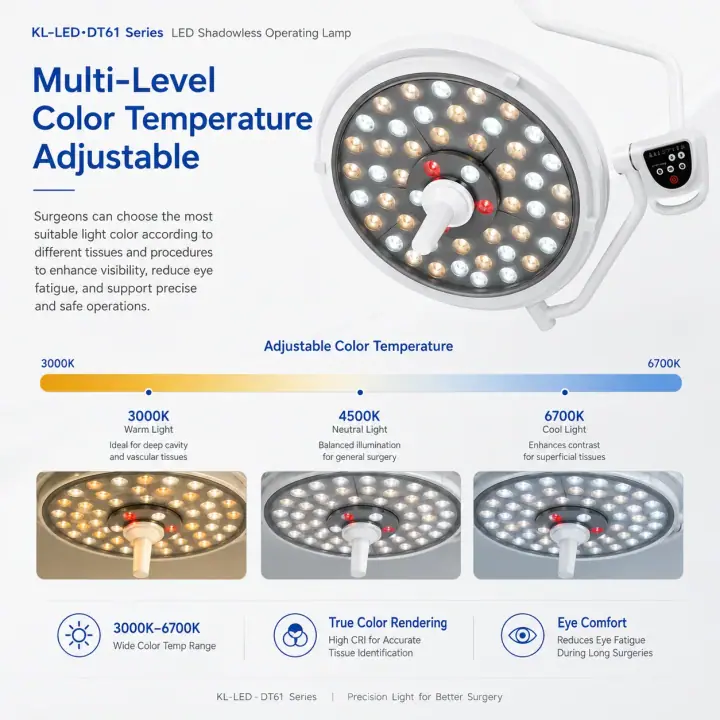
- Double-dome and integration options — two heads, Endo mode, HD/4K cameras and monitor arms on one central axis, e.g. the KL-LED-DTR78.
Considerations
- Requires a ceiling survey and anchor plate; Keling ceiling lights are designed for 270–320 cm installation heights.
- Installation must be coordinated with HVAC (laminar flow), pendants and other ceiling equipment.
- Less flexible if the room's use changes.
Mobile surgical lights
Advantages
- No structural work — deliver, unpack, plug in. Ideal for refurbishments and rented buildings.
- Flexibility — one light can serve several rooms.
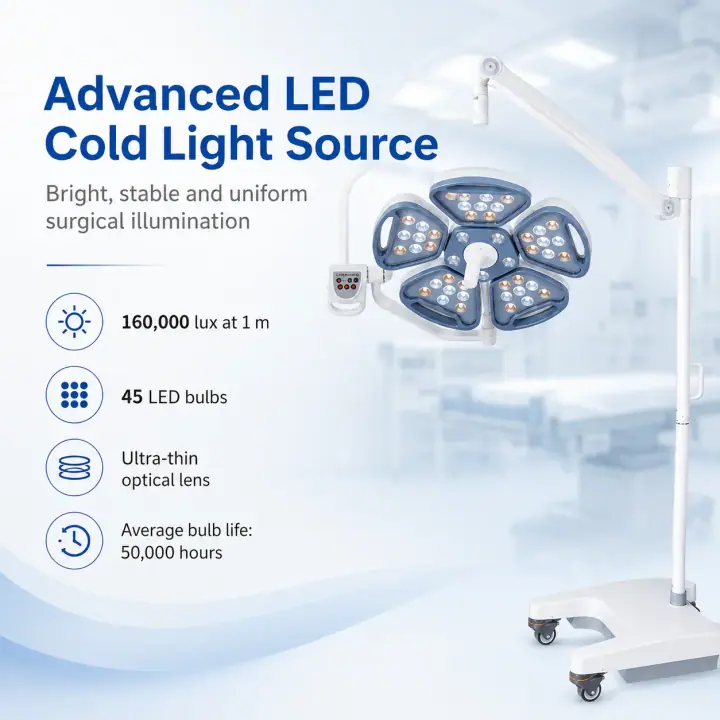
- Same optics — the KL-LED-MSTZ5 uses the same five-petal, 45-LED optical system as the ceiling STZ5, delivering 160,000 lux.
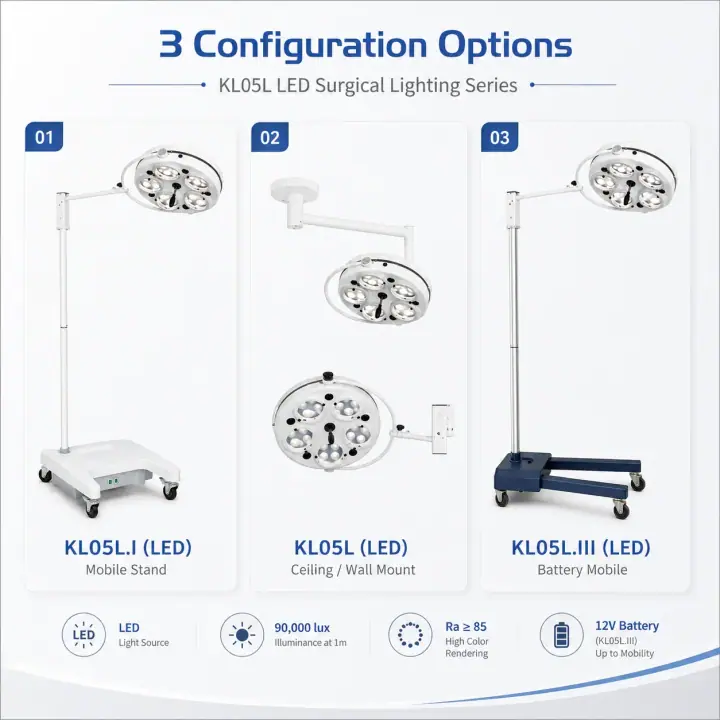
- Battery options — the KL05L-LED mobile variant carries 2 × 12 V 12 Ah lead-acid batteries for continued illumination during outages.
Considerations
- Occupies floor space around the operating table.
- Castor base must be locked and kept clear of cables.
- Most mobile units carry a single dome, although models such as the KL-LED-MDT6I and KL-LED-MDTR78 are offered in double-dome mobile configurations.
Cost of ownership
The light itself often costs a similar amount in ceiling and mobile versions. The difference lies in installation: ceiling mounting adds structural survey, anchor plate, electrical routing and commissioning. For a tender covering many smaller rooms, mobile units often deliver more illuminated rooms per budget.
Recommendation
Use ceiling-mounted double-dome LED lights for main theatres and specialist ORs; use mobile LED lights for everything else — and specify at least one battery-backed mobile unit per surgical suite as a backup. Explore the full ceiling range and mobile range, or ask our engineers to review your room plans.
Frequently asked questions
Is a mobile surgical light as bright as a ceiling-mounted one?
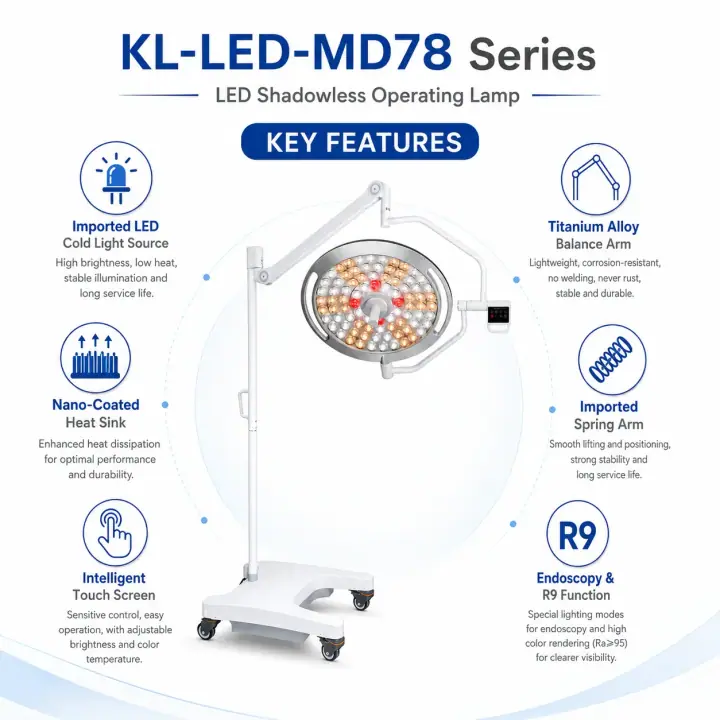
It can be. Keling mobile LED lights such as the KL-LED-MD78, KL-LED-MSTZ4 and KL-LED-MSTZ5 deliver 160,000 lux at 1 m — the same central illuminance as the ceiling-mounted KL-LED-STZ4 and STZ5.
What ceiling height is needed for a ceiling-mounted surgical light?
Keling ceiling-mounted surgical lights are designed for installation heights of 270–320 cm, with a working distance of 70–140 cm. A structural survey of the ceiling slab is required before installation.
When should a hospital choose a mobile surgical light?
Choose a mobile light for procedure rooms, emergency bays, day-surgery units, dental and minor-surgery clinics, temporary or field facilities, and as a supplementary or backup light inside the main operating theatre.