LED vs Halogen Surgical Lights: A Procurement Guide for 2026
LED vs halogen surgical lights compared on illuminance, heat, colour rendering, lifespan and total cost of ownership, with a buyer checklist.

Choosing between LED and halogen surgical lights is one of the first decisions in any operating-theatre fit-out or replacement tender. Halogen lamps built the modern OR; LED has largely replaced them in new installations. This guide explains the practical differences — not marketing claims — so procurement teams, biomedical engineers and distributors can match the technology to the facility.
Short answer: LED surgical lights win on heat, lifespan, energy use and colour control. Halogen lights win on purchase price and on simplicity of field repair. For a main theatre used every day, LED almost always has the lower total cost of ownership.
How the two technologies make light
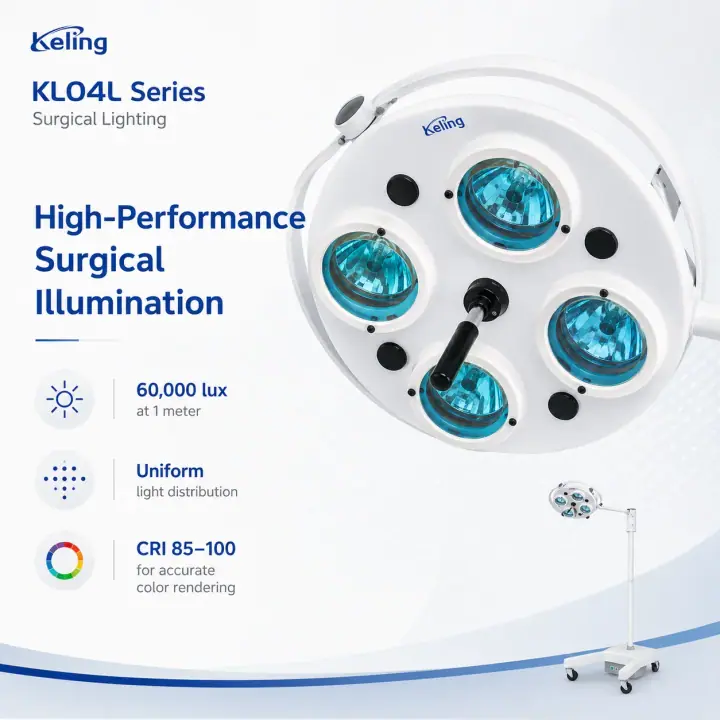
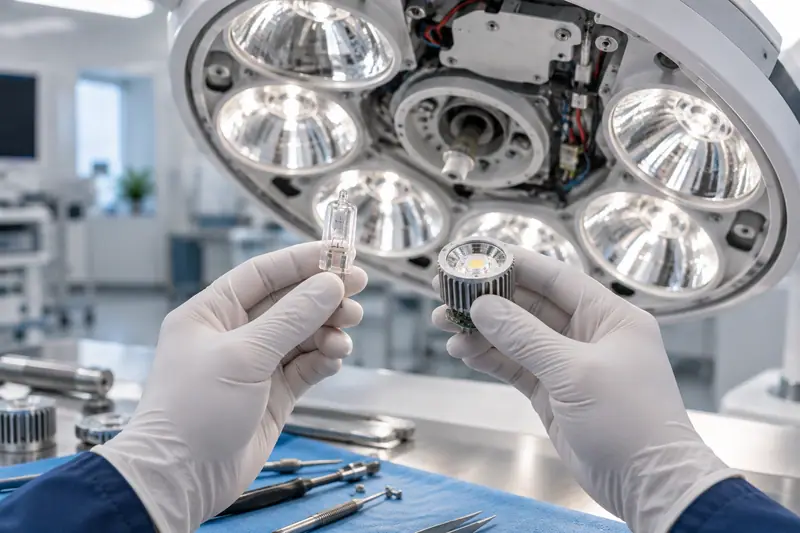
A halogen operating lamp uses one or more tungsten-halogen bulbs (for example 24 V, 100–125 W) behind faceted reflectors. Hole-type designs such as five- or six-hole lamp heads overlap several reflector bays so that a surgeon's head or hands only block part of the light.
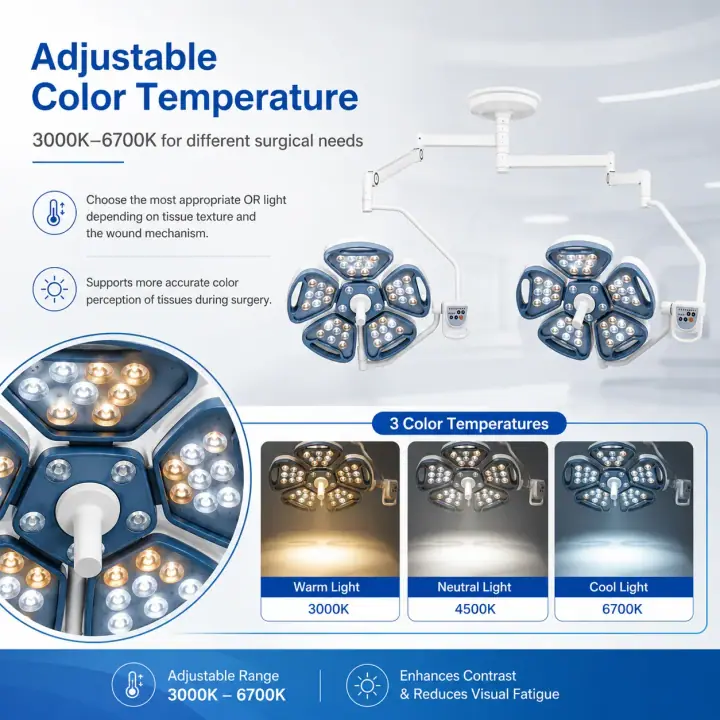
An LED surgical light uses dozens to hundreds of individual light-emitting diodes, each with its own lens. The Keling KL-LED-STZ5 places 45 LEDs per dome using a computer-programmed optical layout; the KL-LED-DTR78 uses 84 and 144 LEDs in its two domes. Because every LED is an independent source, shadow dilution is built into the geometry.
Side-by-side comparison
| Criterion | Halogen surgical light | LED surgical light |
|---|---|---|
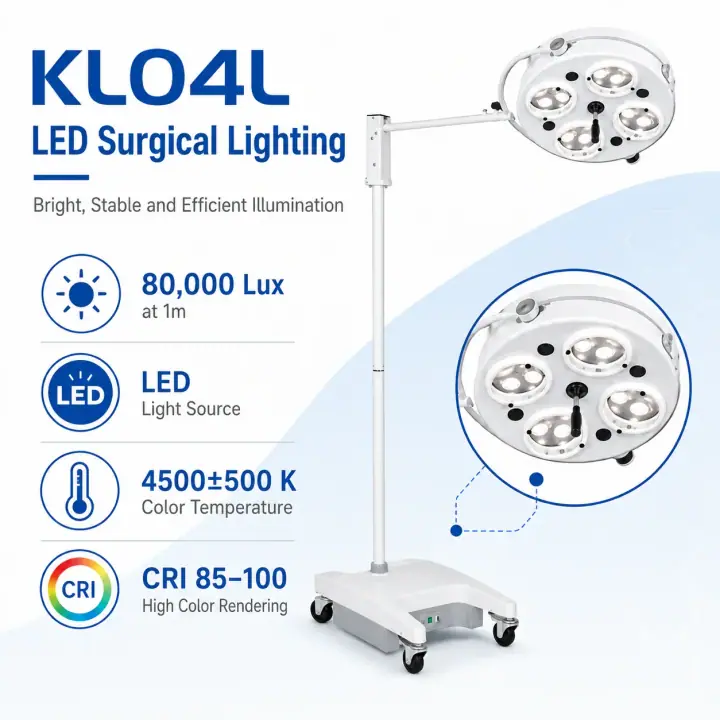
| Typical central illuminance at 1 m | 60,000–80,000 lux (Keling KL04L / KL05L) | 80,000–160,000 lux (Keling LED range) |
| Light-source life | Bulb replacement typically after ~1,000–2,000 h | ~50,000 h rated LED life |
| Heat at the surgical field | Higher; Keling halogen spec <6 mW/m²·lx | Lower; Keling LED spec ≤3.2 mW/m²·lx |
| Colour temperature | Fixed, ~4,500 ± 500 K | Often adjustable 3,000–6,700 K |
| Colour rendering | Ra ≥ 85 | Ra ≥ 85; R9/R11 ≥ 97 on premium models |
| Endoscopic (Endo) mode | Rare | Common (10,000–15,000 lux) |
| Purchase price | Lower | Higher |
| Field serviceability | Very simple (swap bulb) | Modular boards; fewer interventions |
Values refer to Keling Medical product specifications; other manufacturers' figures will vary.
Heat: the factor surgeons notice first
Radiant heat dries exposed tissue and makes long procedures uncomfortable for the surgical team standing under the lamp head. International standard IEC 60601-2-41 (particular requirements for surgical luminaires) limits total irradiance and the ratio of irradiance to illuminance. Keling's halogen lamps are designed to stay below 6 mW/m²·lx and limit patient head temperature rise to ≤2 °C, which meets the requirement. LED models go further, to ≤3.2 mW/m²·lx — roughly half the radiant energy for each lux delivered.
Lifespan and total cost of ownership
The purchase price is only part of the cost. A simple five-year model for one theatre used eight hours a day, five days a week (≈10,400 hours):
- Halogen: expect several bulb replacements per reflector bay over that period, plus downtime and technician visits.
- LED: at a rated 50,000 hours the LED array would typically not need replacement in the same period.
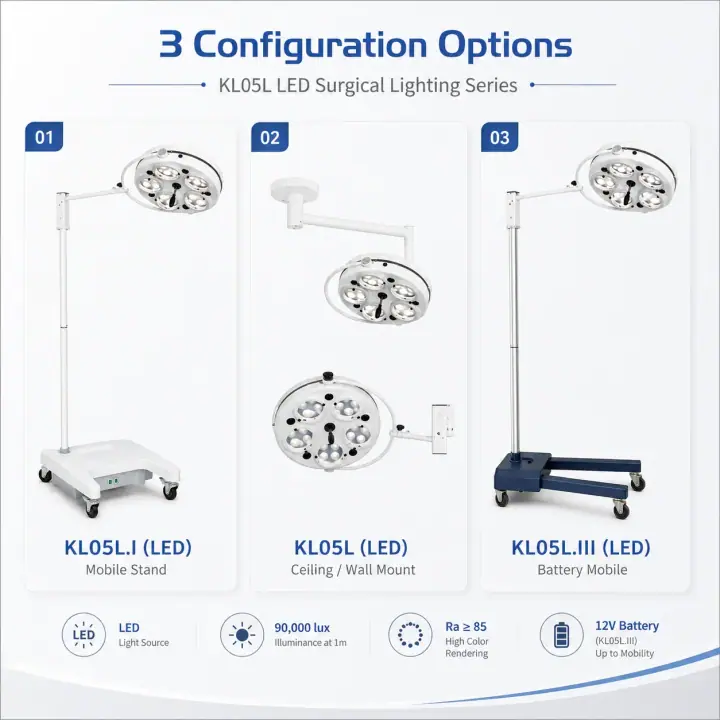
LED lamps also draw less power for the same light output — the Keling KL05L-LED is rated at 36 VA input while delivering 90,000 lux, compared with 150 VA for the halogen KL05L at 80,000 lux.
Colour temperature and tissue contrast
Halogen light is inherently warm. LED engines can mix warm and cool LEDs to offer a range — commonly 3,000–6,700 K. Warmer settings reduce glare and visual fatigue during long cases; cooler settings increase contrast between tissue types. Premium LED heads add high R9 (deep red) and R11 (green) rendering indices, which help distinguish blood-perfused tissue, vessels and fat.
When halogen still makes sense
- Budget-constrained tenders where the lowest compliant price wins.
- Facilities with a stock of compatible bulbs and technicians trained on reflector lamps.
- Battery-backed mobile units for areas with unstable mains power — although LED variants such as the KL05L-LED (with 2 × 12 V 12 Ah batteries) now cover this use case with much longer run times.
A procurement checklist
- Confirm central illuminance (Ec) at 1 m and the light-field diameters D10 and D50.
- Ask for depth of illumination (L1+L2) — 100–150 cm is typical for LED heads.
- Check Ra, and R9/R11 if tissue differentiation matters to your specialties.
- Request the heat-to-light ratio in mW/m²·lx.
- Verify certification: CE, ISO 13485 and any local registration (FDA, SFDA, EFDA, etc.).
- Clarify spare-parts availability and warranty terms in the quotation.
Bottom line
For main operating theatres, LED surgical lights are the default choice in 2026. Halogen operating lamps remain a credible, economical option for secondary rooms and price-driven tenders. Keling Medical manufactures both, which lets distributors offer a complete price ladder from one supplier.
Need a side-by-side quotation? Compare models or request a quote — our export team will prepare a configuration and price for your market.
Frequently asked questions
Are LED surgical lights better than halogen?
For most new operating theatres, yes. LED surgical lights deliver comparable or higher central illuminance (up to 160,000 lux at 1 m) with far less radiant heat, a rated LED life of around 50,000 hours versus roughly 1,000–2,000 hours for a halogen bulb, and adjustable colour temperature. Halogen lamps remain a low-cost, easily serviced option where budgets are tight or replacement bulbs are readily available.
How long does an LED surgical light last?
Keling LED surgical lights are rated for an average LED life of 50,000 hours. At 8 hours of use per day that is more than 17 years of operation before the LEDs reach their rated end of life.
Do LED surgical lights produce heat?
LED surgical lights produce much less radiant heat at the surgical field than halogen lights. Keling LED models specify a heat-to-light ratio of ≤3.2 mW/m²·lx, while halogen models are specified at <6 mW/m²·lx.
Can I upgrade a halogen operating lamp to LED?
Some hole-type lamps are offered in both versions. For example, the Keling KL04L and KL05L series are available as halogen and LED variants sharing the same lamp-head architecture, which raises illuminance (KL04L: 60,000 → 80,000 lux) without changing the mounting format.