Shadowless Lamp Explained: Why Surgical Lights Don't Cast Shadows
What is a shadowless lamp? How surgical lights reduce shadows with multiple light sources, multi-reflector bulbs and LED optics — and why no surgical light is 100% shadowless.

The shadowless lamp — wúyǐngdēng in Chinese, the name Keling has used for its operating lamps since the company was founded in 1996 — is the defining instrument of the operating theatre. Yet surgeons know that a light with "no shadow" doesn't exist. What a good surgical light does is dilute shadows so thoroughly that they don't get in the way. Here's how.
In one sentence: a shadowless lamp lights the wound from many directions at once, so any obstacle only blocks a small fraction of the light and the shadow it casts is faint.
Why ordinary lights cast hard shadows
A single small light source — a bulb, a torch — sends light from one point. Anything between the source and the surface blocks all light along that line, leaving a dark, sharp-edged shadow. In surgery, the obstacles are the surgeon's head, shoulders and hands, plus instruments — exactly where the light is needed.
How surgical lights dilute shadows
1. Large light-emitting surface
The lamp head is wide (often 50–70 cm across) and the light comes from the whole surface. An obstacle near the wound blocks only part of it.
2. Many converging beams
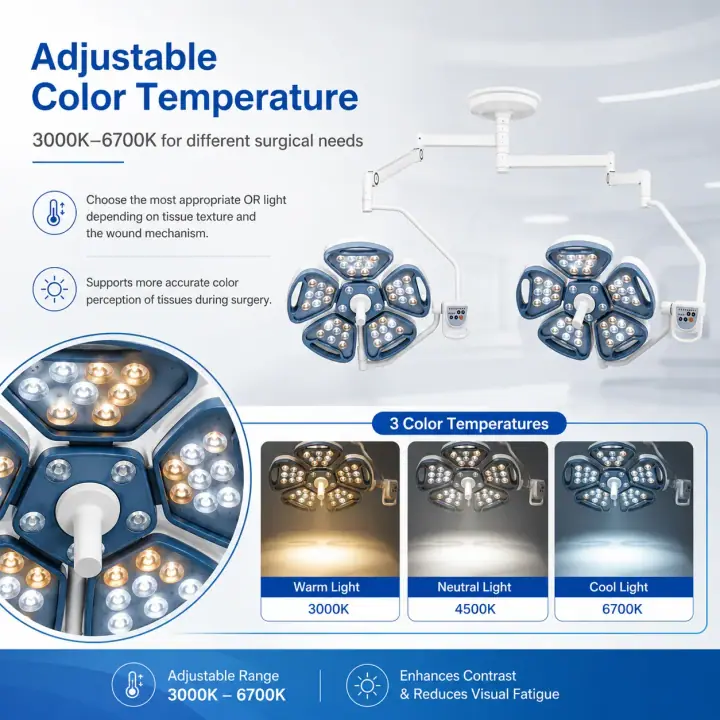
- LED surgical lights use dozens of LEDs, each with its own lens, aimed so their beams converge on the field — for example 45 LEDs per dome on the KL-LED-STZ5, arranged in five petals.
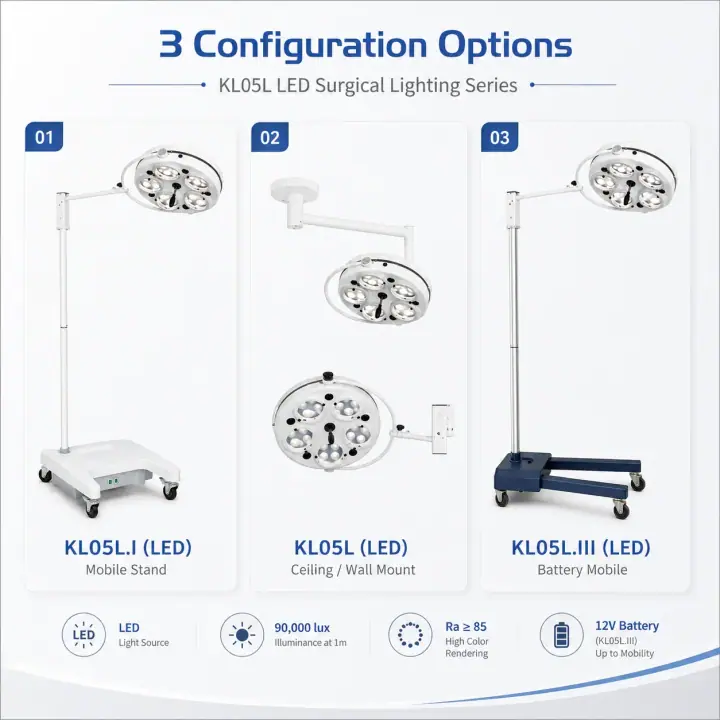
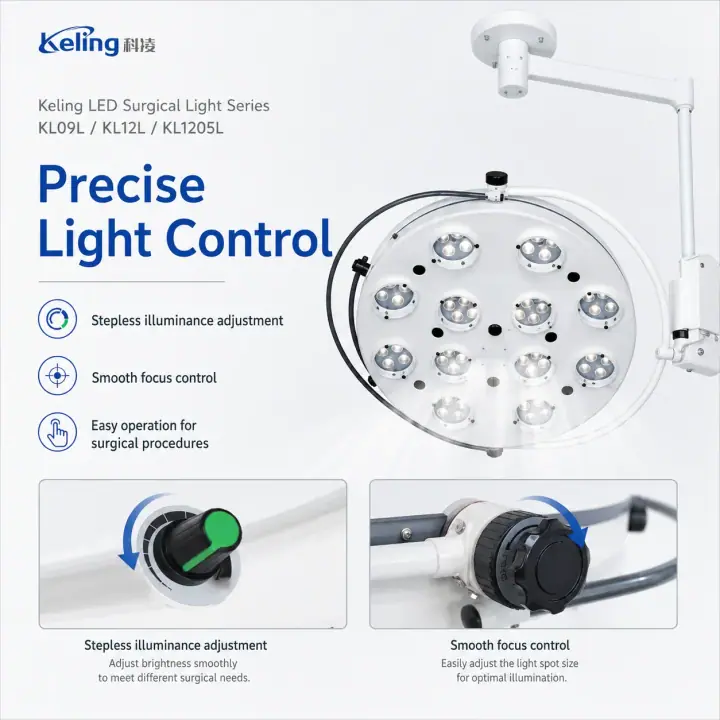
- Multi-reflector (hole-type) lamps use several reflector bays (five, six, nine or twelve "holes") around halogen or LED bulbs — for example the six-hole KL05L-LED and the KL09L / KL12L / KL1205L series.
3. Depth of illumination
Overlapping beams also keep the light bright above and below the focal plane, so when the surgeon works deeper in a cavity, shadows don't suddenly appear. Keling ceiling LED lights specify 150 cm depth (L1+L2).
4. Two lamp heads
In major surgery, a double-dome set-up such as the KL-LED-DT6I lights the field from two widely separated directions — the strongest shadow-dilution strategy there is.
How shadow dilution is tested
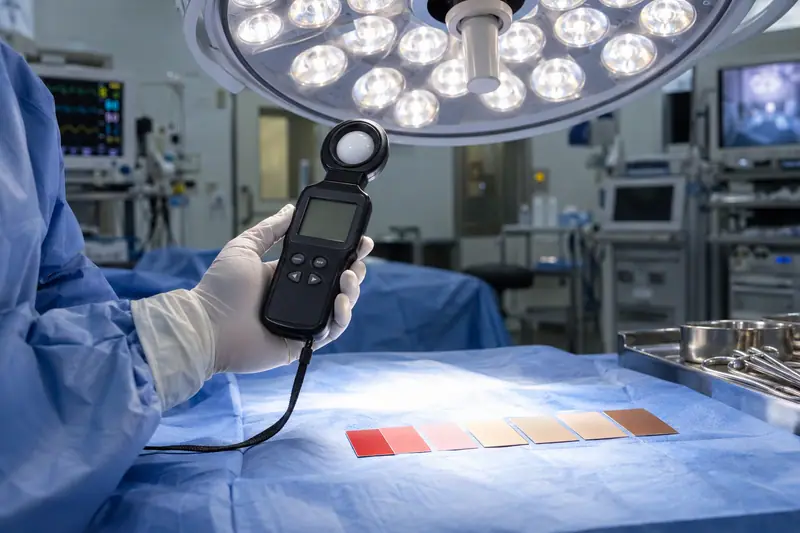
IEC 60601-2-41 defines tests in which masks (simulating a head) and a tube (simulating a cavity) are placed between the lamp and the sensor, and the remaining illuminance is measured as a percentage of the unobstructed value. A higher remaining percentage means better shadow control. Ask suppliers for these figures, not just maximum lux.
Shadowless lamp types compared
| Design | How it controls shadows | Typical use |
|---|---|---|
| LED multi-petal dome | Many LEDs + lenses converge from a wide surface | Main ORs, day surgery |
| Multi-reflector (hole-type) | Several reflector bays around bulbs | Budget ORs, clinics, field hospitals |
| Double dome | Two separate heads | Major surgery, teaching hospitals |
| Examination light | Single small source; limited shadow control | Exams, minor procedures |
More on the trade-offs in LED vs halogen surgical lights and ceiling vs mobile surgical lights.
Tips for the operating team
- Position the lamp head slightly off-axis from the surgeon's line of sight, not directly overhead their head.
- Use the second head from a different direction.
- Increase field size for deep or wide incisions; reduce it for superficial work to cut glare.
- Keep the sterile handle covers clean so the light can be repositioned freely.
Planning a theatre? Ask us which shadowless lamp fits your rooms.
Frequently asked questions
What is a shadowless lamp?
A shadowless lamp (also called a shadowless operating lamp or surgical light) is a luminaire that lights the operative field from many directions at once, so that when a surgeon's head, hands or instruments block part of the light, the rest still reaches the wound and shadows are diluted.
Do surgical lights cast shadows?
Every object casts some shadow, but surgical lights are designed so the shadow is faint. They use many light sources spread across a large lamp head, all focused on one field, so blocking any one of them leaves the others to fill the gap.
How does a shadowless lamp work?
Light comes from a wide area — dozens of LEDs with individual lenses, or several reflector bays around a halogen bulb — and converges on the field from different angles. Overlapping beams fill each other's shadows, which is called shadow dilution.
What is a shadowless bulb?
The term usually refers to the halogen bulb used in a multi-reflector (hole-type) shadowless operating lamp, or to the lamp head as a whole. The bulb itself is not shadowless; the reflector system around it creates the effect.
Are LED surgical lights more shadowless than halogen?
LED lamp heads can distribute many small light sources over a large area with precise lenses, which generally improves shadow dilution and depth. Well-designed multi-reflector halogen lamps also perform well; the optical design matters more than the light source.