Lux to Lumens Calculator: Convert Lumens to Lux (and Back) in Seconds
Free lux to lumens calculator. Convert lumens to lux by area or by beam angle and distance, with formulas, worked examples (100 and 10,000 lux) and a surgical light example.

Converting between lux and lumens needs one extra number: the area the light falls on. Use the calculator below, then read the formulas and worked examples. If you first want the concept, see lux vs lumens explained.
The calculator assumes light is spread evenly over the area. Real luminaires — especially surgical lights — are brightest at the centre and fall off towards the edge, so treat results as averages.
The formulas
- Lumens to lux: lux = lumens ÷ area (m²)
- Lux to lumens: lumens = lux × area (m²)
- Area of a circular spot: area = π × r², where r is the radius in metres
- Spot radius from beam angle: r = distance × tan(beam angle ÷ 2)
- Foot-candles: 1 fc ≈ 10.764 lux
Worked examples
| Question | Calculation | Answer |
|---|---|---|
| 1,000 lm over 2 m² — how many lux? | 1,000 ÷ 2 | 500 lux |
| 100 lux over a 10 m² room — how many lumens? | 100 × 10 | 1,000 lm |
| 10,000 lux over 1 m² | 10,000 × 1 | 10,000 lm |
| 10,000 lux over a 20 cm spot | area = π × 0.1² ≈ 0.0314 m² → 10,000 × 0.0314 | ≈ 314 lm |
| 500 lux in foot-candles | 500 ÷ 10.764 | ≈ 46 fc |
A surgical light example
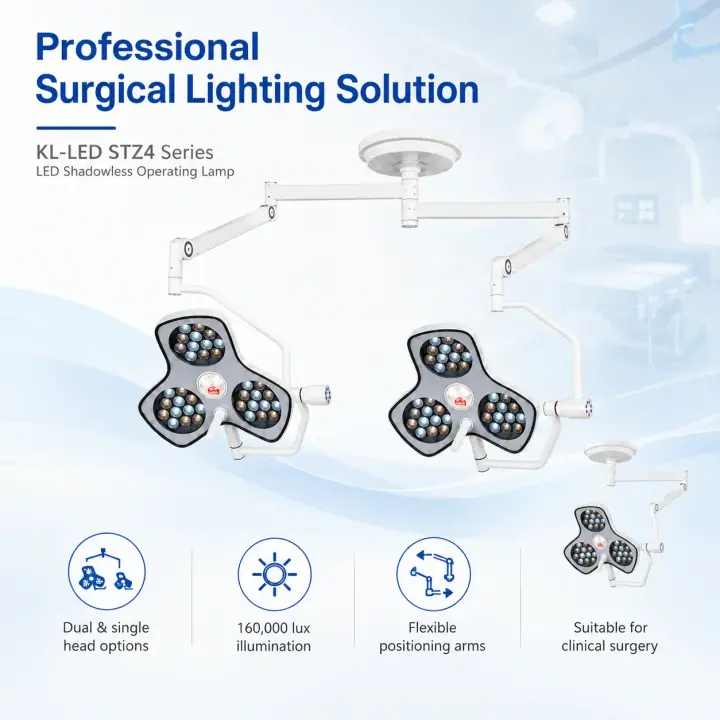
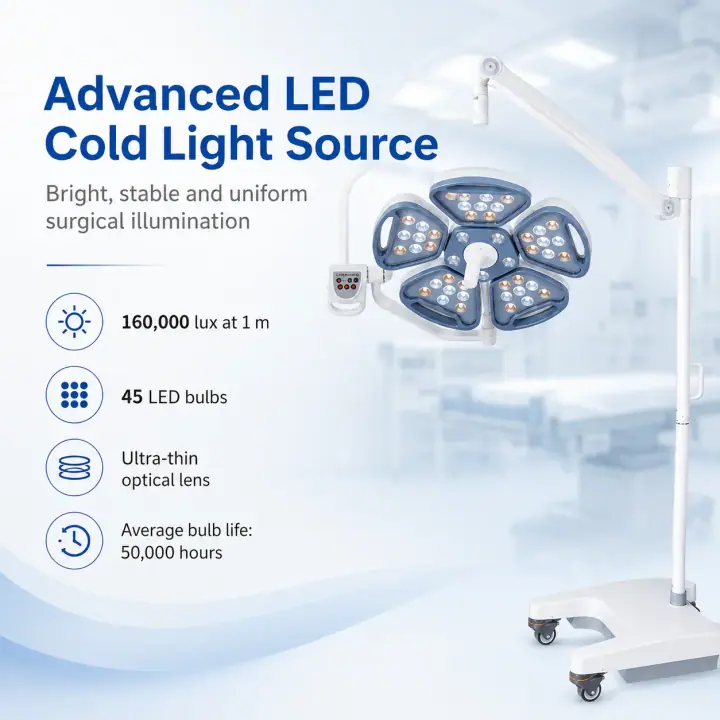
Keling ceiling LED heads such as the KL-LED-STZ4 deliver 160,000 lux at the centre of the field at 1 m, with a light-field diameter adjustable between about 10 and 28 cm.
If, for illustration, that 160,000 lux were spread evenly over a 20 cm diameter field (≈ 0.0314 m²), the luminous flux reaching the field would be about 160,000 × 0.0314 ≈ 5,000 lumens. Because real surgical light fields are brightest in the centre, the true flux is lower — which is exactly why IEC 60601-2-41 specifies central illuminance in lux plus field diameters D10 and D50, rather than lumens.
Why manufacturers quote lux for surgical lights
- Lux describes what the surgeon actually sees at the wound.
- It is measured at a standard distance (1 m) so lamps are comparable.
- It is combined with D10/D50 to describe the size and evenness of the field.
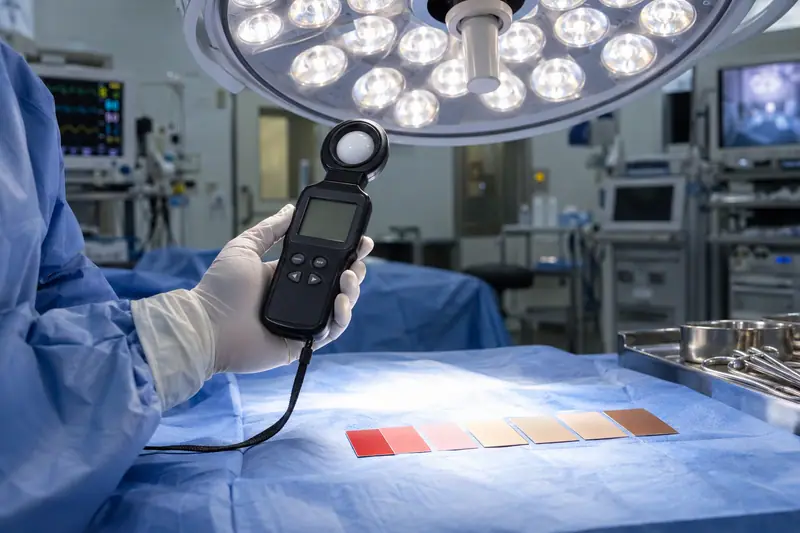
Read more in surgical light lux requirements and how to use a lux meter.
Converting halogen to LED: lumens are not enough
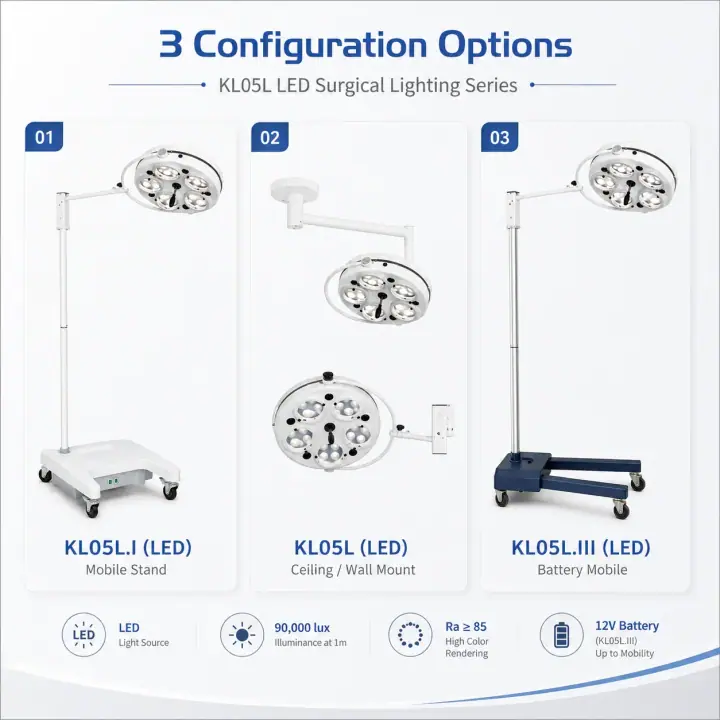
When replacing a halogen bulb, people often compare lumen figures. In a surgical lamp, the reflector or lens system decides how those lumens become lux at the field, so a lamp should be converted only with the manufacturer's approved LED version — for example the KL05L-LED (90,000 lux) instead of the halogen KL05L (80,000 lux). See replacing halogen with LED.
Need lux figures for a tender? Ask our engineers.
Frequently asked questions
How do you convert lux to lumens?
Multiply lux by the illuminated area in square metres: lumens = lux × area (m²). For example, 500 lux evenly over 4 m² needs 2,000 lumens.
How do you convert lumens to lux?
Divide lumens by the area in square metres: lux = lumens ÷ area (m²). 1,000 lumens spread evenly over 2 m² gives 500 lux.
How many lumens is 10,000 lux?
It depends on the area. 10,000 lux over 1 m² is 10,000 lumens; over a 20 cm diameter spot (about 0.031 m²) it is only about 314 lumens.
How many lumens is 100 lux?
100 lux over a 10 m² room corresponds to 1,000 lumens reaching the floor; over 1 m² it is 100 lumens.
Can I convert lux to lumens without knowing the area?
No. Lux is lumens per square metre, so the area (or the beam angle and distance, which define the area) is always needed.