How to Use a Lux Meter: Measuring Lux (and Lumens) Correctly
How a lux light meter works, the lux measurement unit, a step-by-step method for measuring lux at a surgical or examination light, and why a lux meter cannot measure lumens directly.

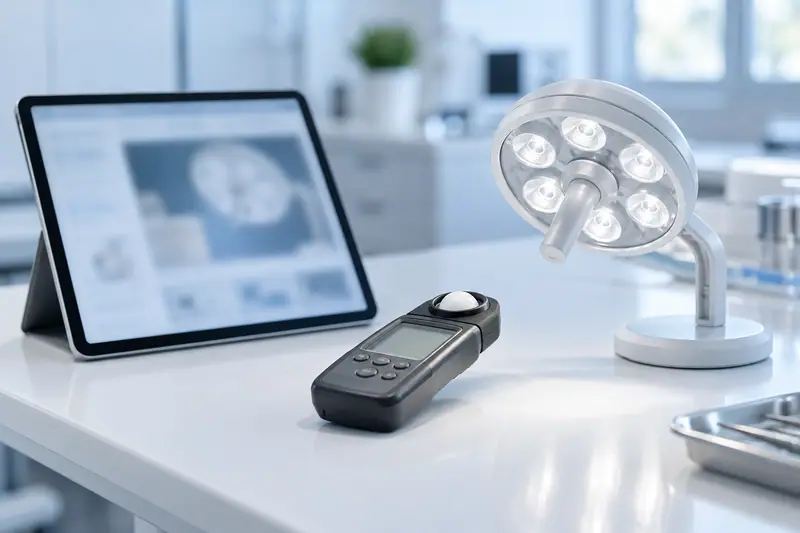
A lux meter (also called a lux light meter or illuminance meter) tells you how much light is falling on a surface. It is the tool biomedical engineers use to accept a new surgical light, check an examination lamp after service, or verify that a ward meets its lighting design. This guide explains the lux measurement unit, how the meter works, and a repeatable method for measuring lux — plus why a "lumens meter" is a different instrument.
Quick answer: hold the sensor flat at the point of interest, facing the light, keep your body out of the beam, subtract ambient light and read the value in lux. For surgical lights, measure at the centre of the field, 1 m from the light-emitting surface.
The lux measurement unit
- Lux (lx) = lumens per square metre — the SI unit of illuminance.
- Foot-candle (fc) = lumens per square foot ≈ 10.764 lux. US meters often switch between the two.
- Lumen (lm) = total light emitted by a source. See lux vs lumens for the difference.
How a lux meter works
A lux meter has three parts:
- A photodiode sensor behind a diffuser, usually on a cable so your hand does not shade it.
- A V(λ) filter that weights the light the way the human eye does, so readings are photometric rather than raw radiometric power.
- A cosine-corrected diffuser, so light arriving at an angle is counted correctly.
Good meters state their accuracy class, spectral mismatch (f1′) and cosine error. For LED lights, choose a meter specified for LED sources — cheap meters calibrated only for incandescent light can read LEDs high or low.
Range matters for surgical lights
Many low-cost meters stop at 20,000 or 50,000 lux. A modern LED surgical light delivers up to 160,000 lux at 1 m (for example the KL-LED-STZ5), so you need a meter rated to at least 200,000 lux.
Step-by-step: measuring lux at a surgical or examination light
- Warm up the light for several minutes at full intensity and default colour temperature.
- Darken the room or switch off other lights, then measure ambient illuminance with the surgical light off.
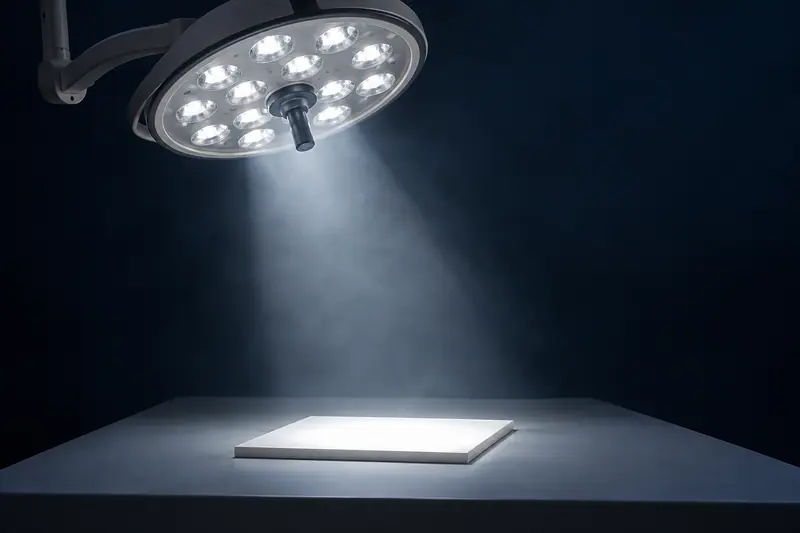
- Set the distance: 1 m from the light-emitting surface to the sensor, measured with a tape or laser rangefinder.
- Focus the lamp to its smallest standard field (or the field stated in the datasheet).
- Place the sensor flat, facing the lamp, at the centre of the light field. Use a tripod or a stand — never hold the sensor in your hand.
- Stay out of the beam and away from white coats or reflective trays.
- Find the peak: move the sensor slowly a few centimetres around the centre and record the highest stable reading.
- Subtract ambient light. The result is central illuminance (Ec).
- Map the field (optional): measure outward along two perpendicular lines until the reading falls to 50% and 10% of Ec — those diameters are D50 and D10.
- Record the meter model, serial number, calibration date, CCT setting and distance.
| What to check | Typical target | Notes |
|---|---|---|
| Central illuminance, surgical light | 40,000–160,000 lx at 1 m | IEC 60601-2-41 range |
| Central illuminance, examination light | ~30,000–80,000 lx | Model dependent; see examination lights guide |
| Endo mode | Low, e.g. 10,000–15,000 lx | For minimally invasive surgery |
| D50 vs D10 | D50 should be a substantial share of D10 | Indicates field evenness |
For room-level targets read surgical light lux requirements.
Measuring lumens: what a "lumens meter" really is
A lux meter cannot read lumens directly. Total luminous flux is measured with:
- an integrating sphere, which collects all the light from a lamp; or
- a goniophotometer, which measures intensity in every direction.
In the field you can estimate lumens on a surface by taking a grid of lux readings over a known area, averaging them and multiplying by the area. Our lux to lumens calculator does the arithmetic.
Common mistakes
- Measuring at the lamp glass instead of 1 m away.
- Tilting the sensor, which lowers the reading.
- Leaving operating-room ceiling lights on.
- Using a meter with too low a range, so it saturates.
- Using an uncalibrated phone app for acceptance tests — apps are fine for rough checks only.
When to measure
- Factory acceptance before shipment — agree the inspection protocol with your supplier (see sourcing surgical lights from China).
- Site acceptance after installation.
- Preventive maintenance at least once a year — see surgical light maintenance.
- After any repair, LED board or bulb replacement.
Need test values for a tender or acceptance protocol? Ask our engineers.
Frequently asked questions
What does a lux meter measure?
A lux meter measures illuminance — the amount of light falling on its sensor — in lux (lx), or in foot-candles on some meters. One lux equals one lumen per square metre.
What is the lux measurement unit?
The lux (symbol lx) is the SI unit of illuminance, defined as 1 lumen per square metre. 1 foot-candle is about 10.764 lux.
Can a lux meter measure lumens?
Not directly. A lux meter reads light per square metre at one point. Total lumens are measured with an integrating sphere or a goniophotometer, or estimated by averaging many lux readings over a known area and multiplying by that area.
How do you measure the lux of a surgical light?
Set the lamp to full output and focus it, place the meter sensor flat and centred in the light field 1 m from the light-emitting surface, keep people and reflective objects out of the beam, subtract ambient light, and record the highest stable reading as central illuminance.
Does a lux meter need calibration?
Yes. Photometric sensors drift with time and temperature. For acceptance tests and audits, use a meter with a valid calibration certificate, typically renewed every one to two years.
Why is my lux meter reading different from the datasheet?
Common causes are measuring at the wrong distance, not centring the sensor, ambient light, a tilted sensor, low battery, a meter not designed for LED spectra, or a light not set to maximum and correctly focused.