Medical Examination Lights: Types, Lux, Mounting and How to Choose
A buyer's guide to medical examination lights and procedure lights: mobile, wall-mounted and ceiling-mounted exam lights, LED vs halogen, lux and CRI, and recommended models for exam rooms.

The examination light is the most common light in any clinic: general practice, gynaecology, ENT, dermatology, emergency, wound care, veterinary and dental rooms all rely on one. It's simpler than a surgical light, but choosing the right medical exam light still makes a big difference to diagnostic confidence and staff comfort.
Quick guide: for most rooms, choose an LED exam light with ≥ 40,000 lux at its working distance, Ra ≥ 85, a flexible arm and the mounting that fits the room — mobile, wall or ceiling.
Examination light vs surgical light vs procedure light
| Aspect | Examination light | Procedure / minor surgery light | Surgical light |
|---|---|---|---|
| Typical illuminance | ~20,000–80,000 lux | ~40,000–100,000 lux | 40,000–160,000 lux at 1 m |
| Shadow control | Limited (single source) | Moderate | High (multi-source) |
| Field size | Small spot | Medium | Large, adjustable |
| Typical rooms | Exam rooms, wards, GP | Treatment, dental, day procedures | Operating rooms |
For true surgery read operating room lights or shadowless lamps explained.
Mounting options
Mobile examination light (floor stand)
Wheeled base, movable between rooms. Ideal for shared rooms, home-care and veterinary use.
Wall mounted examination light
Fixed bracket and swing arm; frees floor space and is always ready. Common in GP rooms, gynaecology and ENT.
Ceiling mounted exam light
Out of the way of trolleys and staff; used in emergency bays and treatment rooms.
Key specifications
- Illuminance at a stated distance (1 m or 0.5 m — compare like with like).
- Colour temperature — fixed (~4,500 K) or adjustable. See what CCT means.
- Colour rendering Ra — ≥ 85; higher (Ra ≥ 95) helps dermatology and wound assessment. R9 improves the rendering of red tissue.
- Arm — reach, stability and range of tilt.
- Brightness control — multi-level dimming.
- Heat — LED keeps the patient comfortable during long exams.
- Cleanability — smooth housings that tolerate hospital disinfectants.
Keling examination lights compared
| Model | Light source | Illuminance | CCT | Ra | Mounting |
|---|---|---|---|---|---|
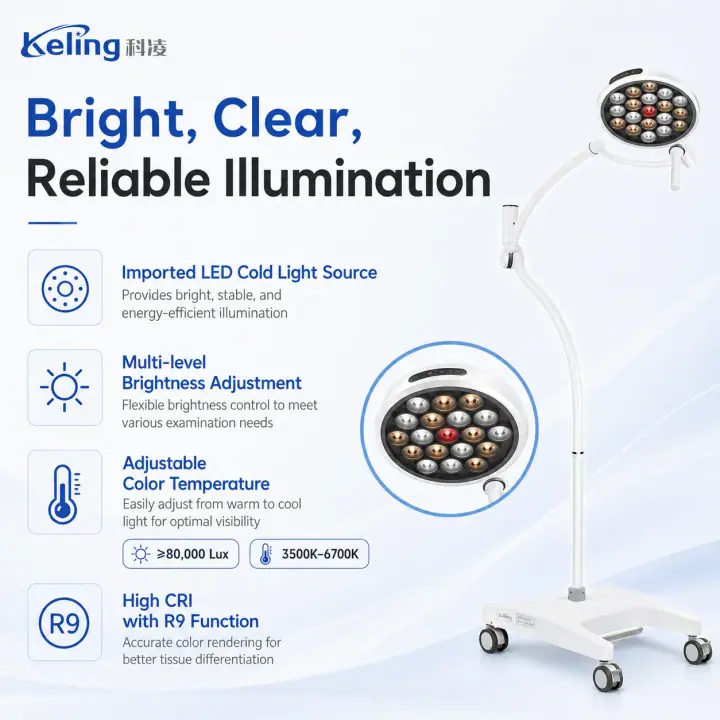
| KL01L-IILEDTR | LED | ≥ 80,000 lux at 1 m | 3,500–6,700 K adjustable | ≥ 85, R9 function | Mobile, wall, ceiling |
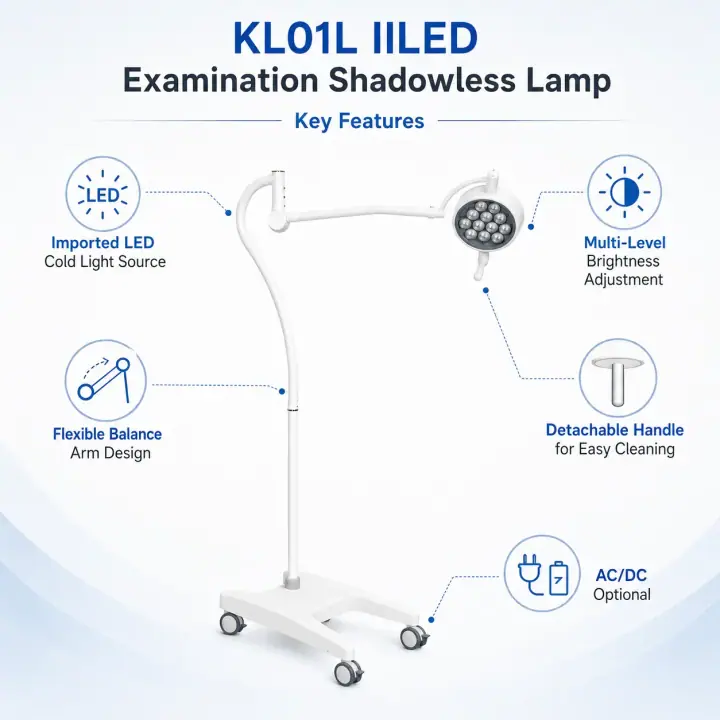
| KL01L-IILED | LED | ≥ 60,000 lux at 1 m | 3,500–6,700 K adjustable | ≥ 85 | Mobile, wall, ceiling |
| KL01L-ILED-I | LED | ≥ 40,000 lux at 1 m; ≥ 60,000 at 0.5 m | 4,500 ± 500 K | ≥ 95 | Mobile, wall |
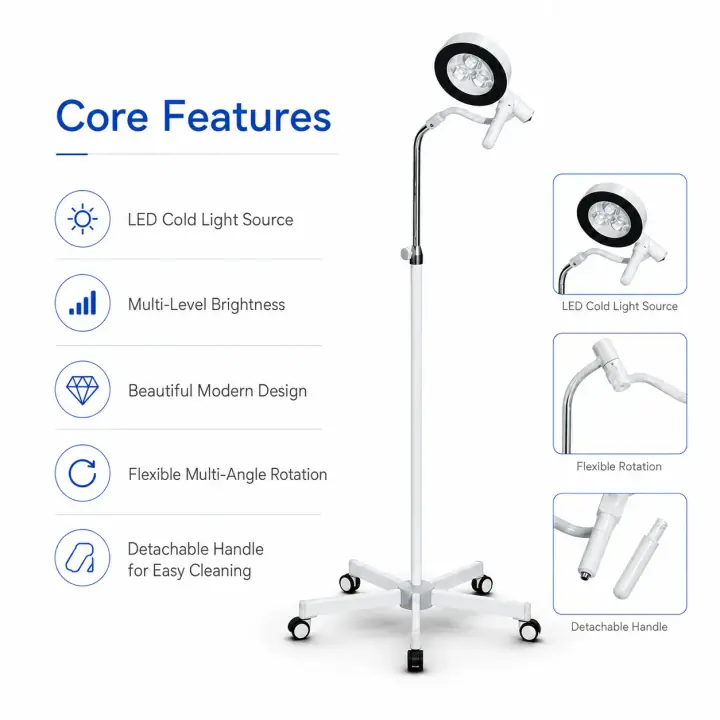
| KL01L-ILED / IILED-I | LED | ≥ 30,000 lux at 1 m | 4,500 ± 500 K | ≥ 85 | Mobile |
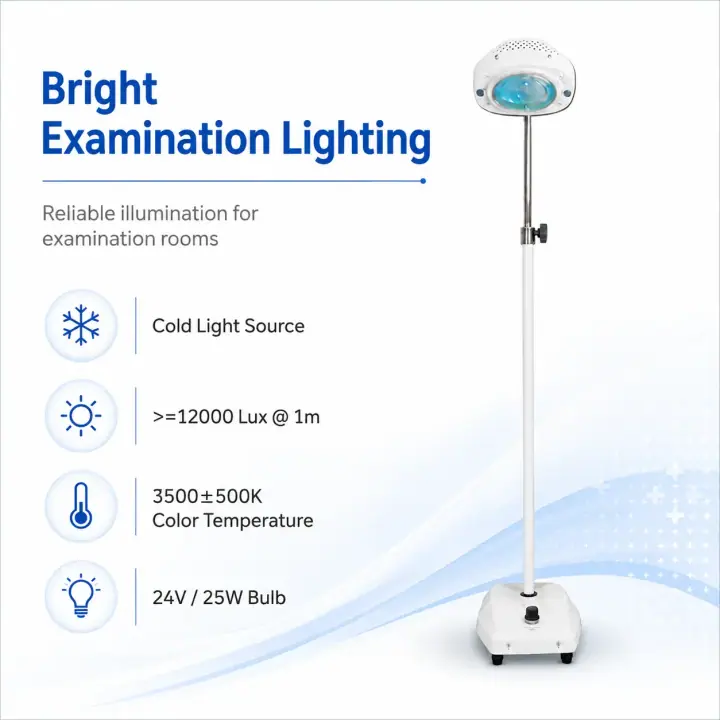
| KL01L-IP | Cold-light halogen, 24 V 25 W | ≥ 12,000 lux at 1 m | 3,500 ± 500 K | — | Mobile |
All models: examination lights.
Which exam light for which room?
| Room | Suggested choice |
|---|---|
| Gynaecology / obstetrics | Bright LED with adjustable CCT — KL01L-IILEDTR or KL01L-IILED |
| Dermatology, wound care | High CRI — KL01L-ILED-I (Ra ≥ 95) |
| General practice | Compact LED — KL01L-ILED / IILED-I |
| Emergency / treatment bay | Ceiling or wall LED, high lux |
| Dental and minor surgery | A dedicated dental/minor surgery light — see dental operatory lights |
| Budget wards | KL01L-IP cold-light |
Medical exam room lighting beyond the lamp
The exam light is task lighting. The room still needs even general lighting (often around 500 lux for exam rooms in many guidelines) with good colour rendering. See the hospital lighting guide.
Measuring and maintaining exam lights
Check output annually with a lux meter (how to use a lux meter), clean the lens weekly, and inspect arm springs and joints. More in surgical light maintenance.
Equipping several clinics? Send us your room list for a mixed examination-light quotation.
Frequently asked questions
What is a medical examination light?
A medical examination light is a focused, adjustable lamp used to illuminate a small area of the body during examinations and minor procedures. It is less powerful than a surgical light and is usually mounted on a mobile stand, wall bracket or ceiling arm.
How bright should an exam light be?
Most LED examination lights deliver roughly 20,000–80,000 lux at their working distance. Keling examination lights range from at least 12,000 lux (KL01L-IP, cold-light halogen) to at least 80,000 lux (KL01L-IILEDTR, LED) at 1 m.
What is the difference between an examination light and a surgical light?
A surgical light (IEC 60601-2-41 surgical luminaire) delivers 40,000–160,000 lux over a large, shadow-diluted field with deep illumination and is used for surgery. An examination light is smaller and simpler, with less shadow control, and is used for examinations and minor procedures.
Should I choose a wall mounted or mobile exam light?
Wall-mounted exam lights save floor space and are always in place; mobile exam lights can be shared between rooms. Ceiling-mounted exam lights suit busy procedure rooms where floor and wall space are both needed.
Are LED exam lights better than halogen?
Generally yes: LED exam lights run cooler, last much longer, use less power and often offer adjustable colour temperature. Halogen models are cheaper to buy.