Lux vs Lumens: What Lux Means and Why Surgical Lights Are Rated in Lux
What is lux? A clear lux definition, how lux differs from lumens, a lux brightness scale from 10 lux to sunlight, and why surgical lights are specified in lux.

Lux is the unit of illuminance — how much light lands on a surface. Lumens measure how much light a source emits in total. The two are related, but they answer different questions, and confusing them is the most common mistake in lighting specifications. This guide gives a plain lux definition, a brightness scale you can picture, and explains why every surgical light datasheet — including Keling's — quotes lux.
In one sentence: 1 lux = 1 lumen per square metre. Lumens tell you how much light a lamp produces; lux tells you how bright the target is.
The lux definition
Lux (symbol lx) is the SI unit of illuminance. One lux is the illuminance produced when one lumen falls evenly on one square metre:
1 lx = 1 lm / m²
In imperial units, illuminance is sometimes given in foot-candles (fc): 1 fc = 1 lumen per square foot ≈ 10.764 lux.
What lumens measure
A lumen (lm) is the unit of luminous flux — the total amount of visible light a source emits, weighted for the sensitivity of the human eye. A light bulb's packaging lists lumens because it describes the bulb itself, regardless of where you put it.
Lux vs lumens: the key difference
| Aspect | Lumens (lm) | Lux (lx) |
|---|---|---|
| Quantity | Luminous flux | Illuminance |
| Describes | Light emitted by the source | Light received by a surface |
| Depends on distance? | No | Yes — falls with distance |
| Depends on beam angle? | No | Yes — a narrow beam gives more lux |
| Typical use | Bulbs, LED modules | Workplaces, roads, surgical lights |
A torch and a ceiling lamp can emit the same number of lumens. The torch concentrates them into a small spot, so the spot has high lux; the ceiling lamp spreads them over a room, so each point has low lux. Need the numbers? Use our lux to lumens calculator.
Lux brightness scale
| Situation | Approximate illuminance |
|---|---|
| Full moon on a clear night | < 1 lux |
| Dim room at dusk, candle-lit space | ~10 lux |
| Corridor or living room | ~50–150 lux |
| Office desk | ~300–500 lux |
| Detailed work, inspection | ~750–1,000 lux |
| Overcast day outdoors | ~1,000–10,000 lux |
| Direct sunlight | ~32,000–100,000+ lux |
| Examination light at the target | ~30,000–80,000 lux |
| Surgical light at 1 m (IEC 60601-2-41 range) | 40,000–160,000 lux |
Values are typical orders of magnitude; real readings vary with conditions.
Why surgical lights are specified in lux
A surgeon cares about the light on the operative field, so the international standard for surgical luminaires, IEC 60601-2-41, specifies central illuminance (Ec) in lux at 1 m from the light-emitting surface, with an allowed range of 40,000–160,000 lux. That single number lets buyers compare lamps from different manufacturers on equal terms.
Lux alone is not the full picture, though. A good datasheet also gives:
- Light-field diameters D10 and D50 — how wide the illuminated area is.
- Depth of illumination (L1+L2) — how far the light stays bright above and below the focal plane.
- Colour rendering (Ra, R9) and colour temperature — see what CCT means.
For a full walkthrough, read how to choose a surgical light and the surgical light lux requirements by room type.
Lux in practice: Keling reference values
| Model | Type | Central illuminance at 1 m |
|---|---|---|
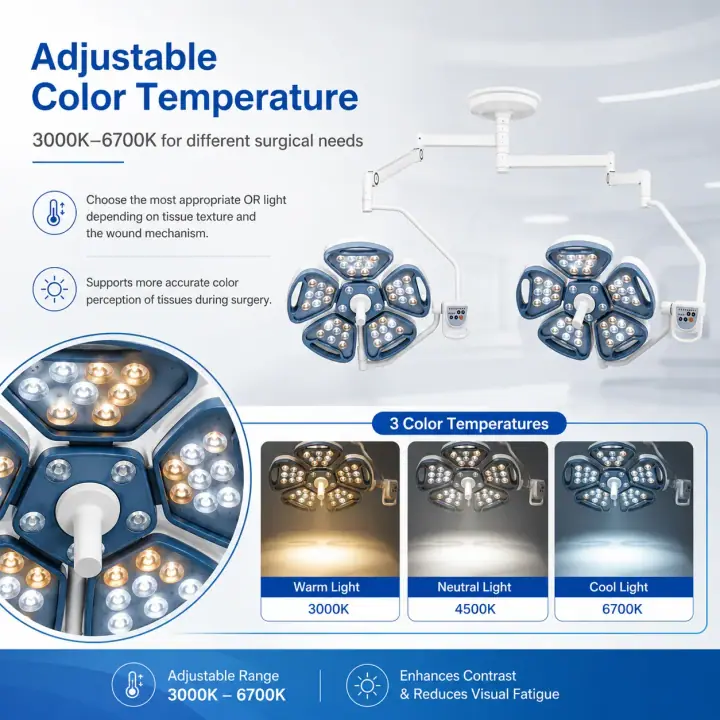
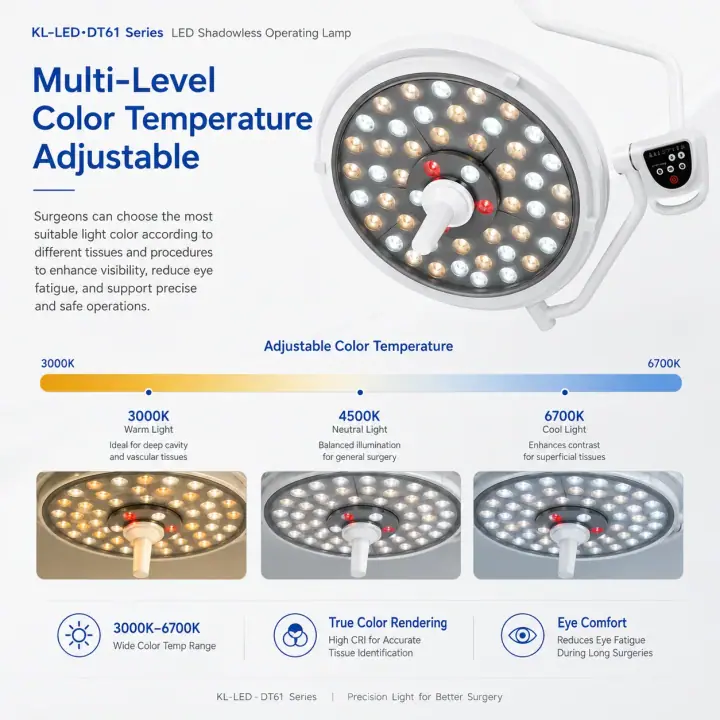
| KL-LED-STZ5 | Ceiling LED, five-petal dome | 160,000 lux |
| KL-LED-DT6I | Ceiling LED, double dome | 160,000 lux per dome |
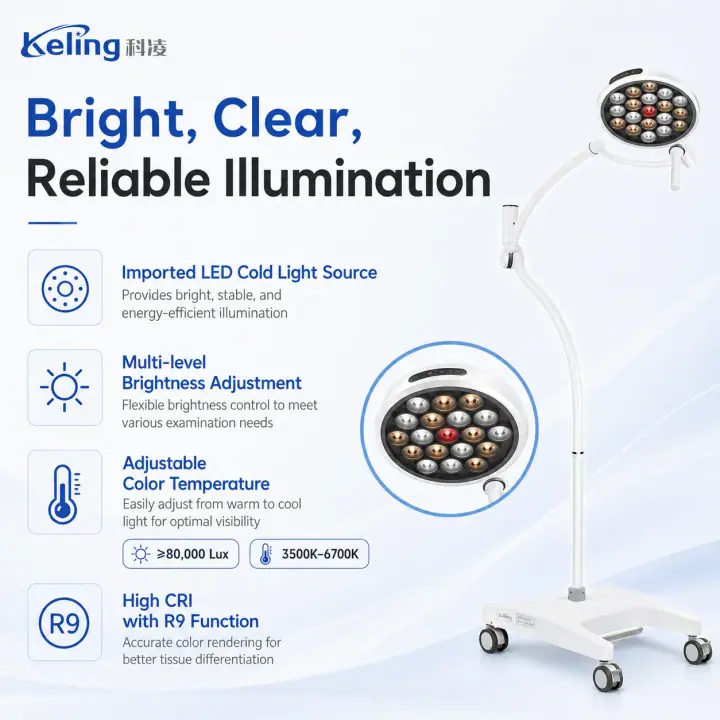
| KL-LED-ST45 | Dental / minor surgery | ≥ 80,000 lux |
| KL01L-IILEDTR | Examination light | ≥ 80,000 lux |
| KL01L-ILED-I | Examination light | ≥ 40,000 lux |
How lux is measured
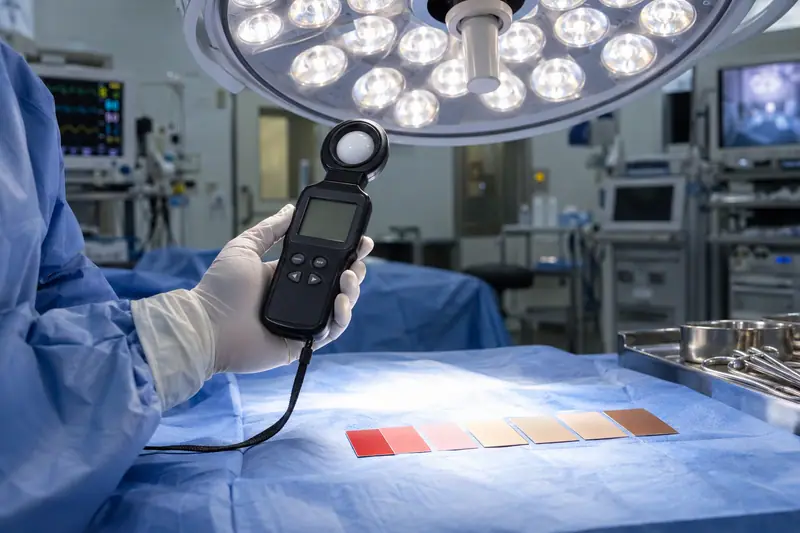
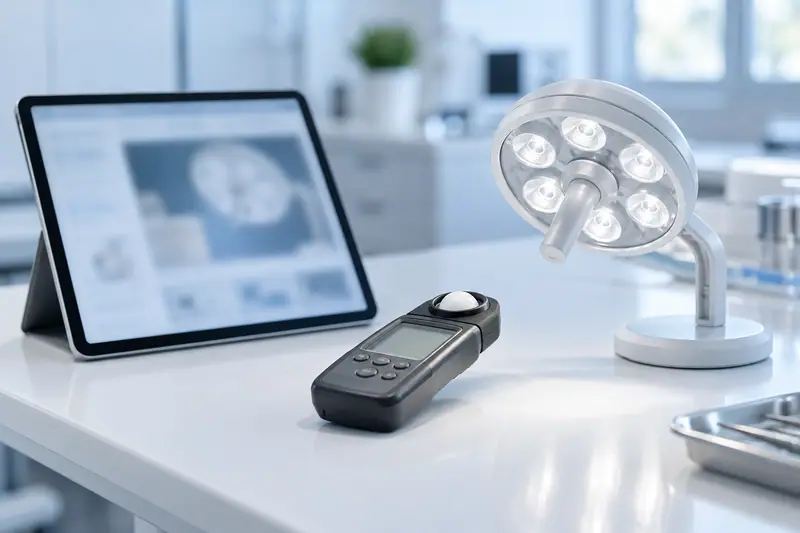
Illuminance is measured with a lux meter: a calibrated photometric sensor placed at the target. For surgical lights the reading is taken at the centre of the light field, 1 m from the lamp. Our step-by-step guide shows how to use a lux meter for acceptance testing.
Key takeaways
- Lux = lumens per square metre; it describes brightness at the target.
- Lumens describe the total output of the source.
- Surgical and examination lights are rated in lux at 1 m so they can be compared directly.
- Always read lux together with field diameter, depth and colour rendering.
Comparing specifications for a tender? Send us your requirements and we will match Keling models to your target lux levels.
Frequently asked questions
What is the definition of lux?
Lux (symbol lx) is the SI unit of illuminance: the amount of light falling on a surface. One lux equals one lumen spread evenly over one square metre (1 lx = 1 lm/m²).
Is lux the same as lumens?
No. Lumens measure the total light a source emits in all directions (luminous flux). Lux measures how much of that light actually lands on a given area. The same lamp gives high lux when its lumens are focused on a small area and low lux when they are spread over a large one.
How bright is 10 lux?
About as bright as a dimly lit room at dusk or a candle-lit space — enough to move around, not enough to read comfortably. Offices are typically lit to roughly 300–500 lux, and a surgical light delivers 40,000 to 160,000 lux at the operative field.
How many lux is sunlight?
Direct sunlight is commonly quoted at roughly 32,000 to over 100,000 lux, depending on time, latitude and atmosphere. An overcast day is often in the region of 1,000–10,000 lux.
Why are surgical lights rated in lux instead of lumens?
Because surgeons care about light on the wound, not light leaving the lamp. IEC 60601-2-41 therefore specifies central illuminance in lux, measured at 1 m from the light-emitting surface — between 40,000 and 160,000 lux for a surgical luminaire.